O Levels/IGCSE Physics (5054)•5054/12/O/N/21
O Levels/IGCSE Physics (5054) — 5054/12/O/N/21, Question 10
Piston X is pushed into a hydraulic cylinder. Piston X produces a pressure Px in the liquid in the cylinder. The diagram shows the cylinder viewed from above. There are two other pistons, Y and Z in the cylinder. The pressures on pistons Y and Z are Py and Pz. What is the relationship between Px, Py, and Pz?
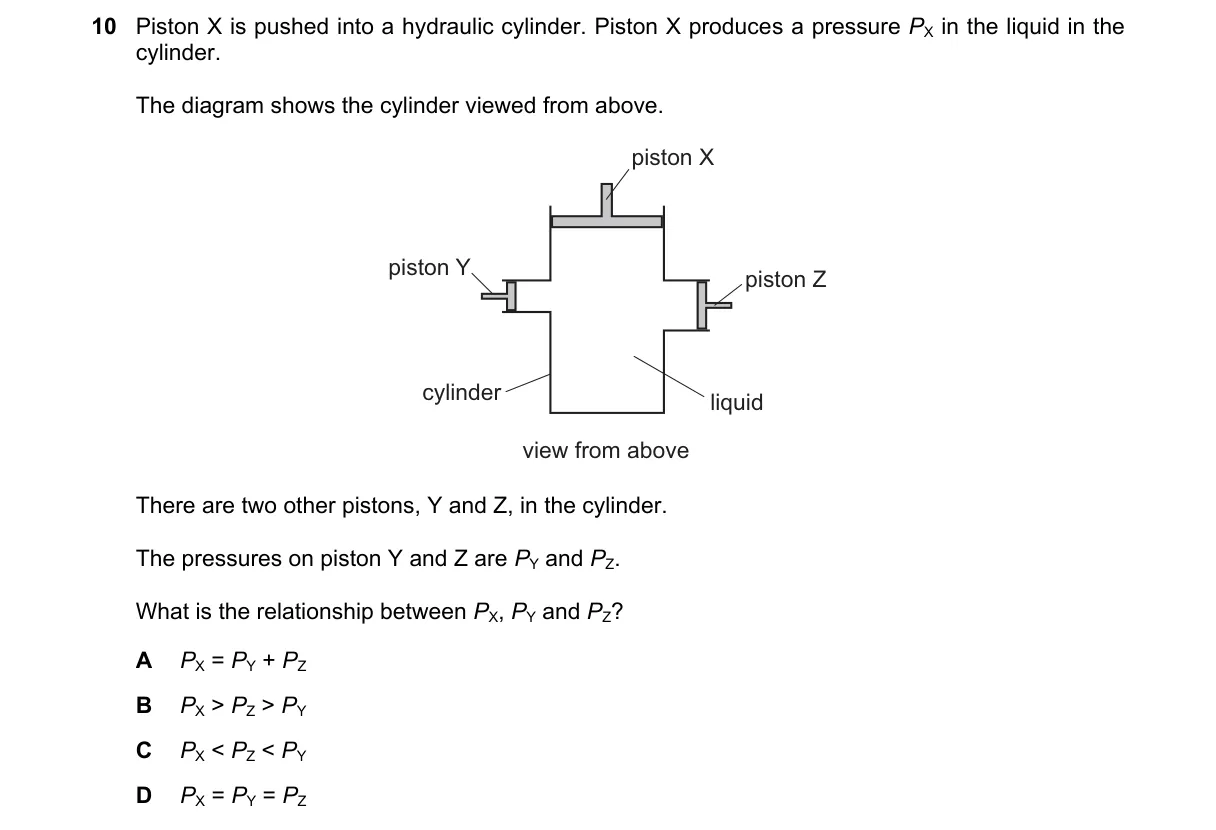
Answer choices
- APx > Py = Pz
- BPy < Px = Pz
- CPx = Py = Pz
- DPx < Py = Pz
Explanation
Pascal's Principle in Hydraulics
Steps:
- Piston X applies force to the fluid, creating pressure Px = force / area of X.
- The fluid is incompressible and enclosed, so pressure transmits equally everywhere per Pascal's law.
- Thus, fluid pressure at pistons Y and Z equals Px, making Py = Pz = Px.
- No height differences or losses indicated in the diagram or question.
Why C is correct:
- Pascal's principle: Pressure applied to an enclosed fluid is transmitted undiminished to every part.
Why the others are wrong:
- A: No mechanism makes Px greater than Py or Pz; pressure equalizes.
- B: Py equals Px, not less; uniform transmission.
- D: Px equals Py and Pz, not less; no hydrostatic variation shown.
Final answer: C
Topic: Pressure
Practice more O Levels/IGCSE Physics (5054) questions on mMCQ.me