O Levels/IGCSE Physics (5054)•5054/11/O/N/21
O Levels/IGCSE Physics (5054) — 5054/11/O/N/21, Question 3
One object falls 200m above Earth's surface. Another object falls from 200m above Moon's surface. One second after they have started to fall, both objects are still 200m above the surface and the weight of each object is constant. There is no atmosphere on the Moon and the weight of each object is constant. Which row describes the motion of both objects at this time? acceleration of the object falling above the Earth's surface acceleration of the object falling above the Moon's surface
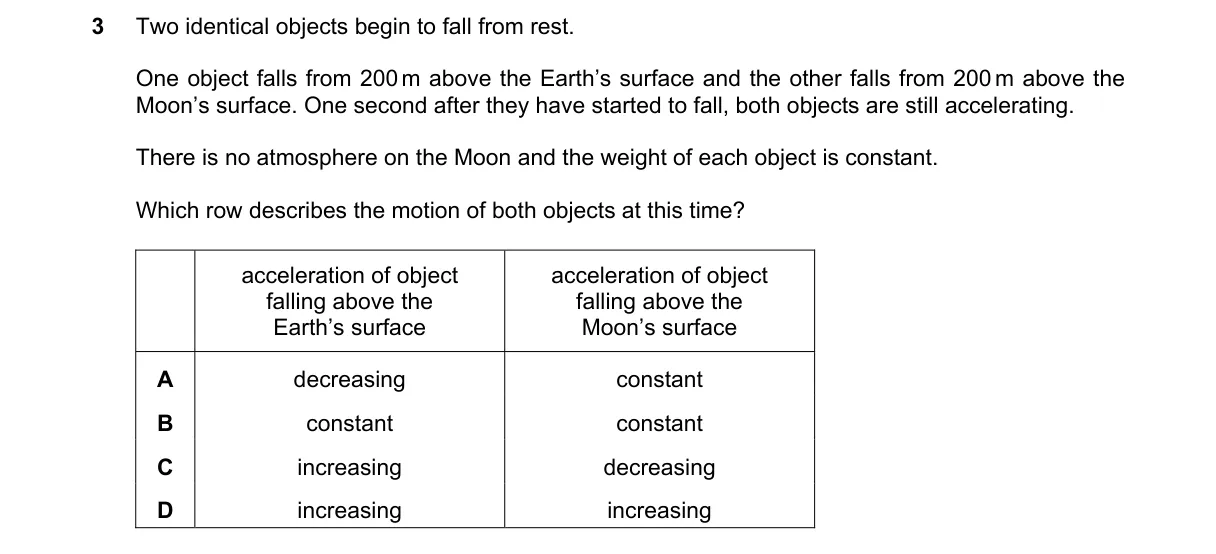
Answer choices
- Adecreasing constant
- Bconstant constant
- Cincreasing decreasing
- Dincreasing increasing
Explanation
Gravitational acceleration vs. air resistance effects
Steps:
- Objects dropped from 200m; after 1s, height change is small (~5m on Earth, ~0.8m on Moon), so still ~200m above surface.
- Weight (mg) constant as height variation negligible; g ≈ constant for both.
- On Moon, no atmosphere, so no drag; acceleration remains constant at g_moon.
- On Earth, atmosphere causes drag force proportional to velocity squared; as speed increases over 1s, drag rises, reducing net acceleration (g - drag/m).
Why A is correct:
- Net acceleration decreases for Earth object due to increasing air resistance (Newton's second law: net force = mg - drag, drag ∝ v²).
Why the others are wrong:
- B: Ignores air resistance on Earth; acceleration not constant there.
- C: Moon acceleration constant, not decreasing; Earth's increases only without drag.
- D: Neither acceleration increases; Earth's decreases due to drag, Moon's constant.
Final answer: A
Topic: Motion
Practice more O Levels/IGCSE Physics (5054) questions on mMCQ.me