O Levels/IGCSE Physics (5054)•5054/11/O/N/21
O Levels/IGCSE Physics (5054) — 5054/11/O/N/21, Question 2
Two forces, X and Y, act upon an object O. The arrows represent the magnitudes and directions of the forces. Which arrow shows the direction of the resultant force?
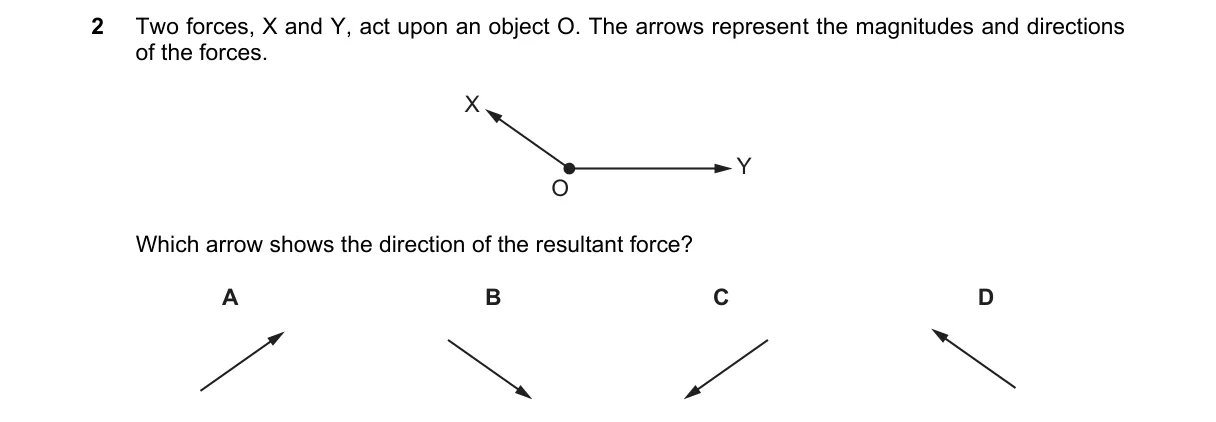
Answer choices
- AOption A
- BOption B
- COption C
- DOption D
Explanation
Resultant Force via Parallelogram Law
Steps:
- Draw force X as one side of a parallelogram.
- Draw force Y parallel to the opposite side, completing the shape.
- The resultant is the diagonal from the object's position, showing net direction.
- Compare diagonals to choice arrows; A aligns with this vector sum.
Why A is correct:
- By the parallelogram law of vector addition, the resultant direction is the diagonal of the parallelogram formed by X and Y, matching arrow A.
Why the others are wrong:
- B points opposite the net pull, ignoring vector addition.
- C aligns with one force only, not the sum.
- D suggests perpendicular resultant, violating the angle between X and Y.
Final answer: A
Topic: Balanced and unbalanced forces
Practice more O Levels/IGCSE Physics (5054) questions on mMCQ.me