O Levels/IGCSE Physics (5054)•5054/11/O/N/21
O Levels/IGCSE Physics (5054) — 5054/11/O/N/21, Question 13
Less thermal energy is needed to raise the temperature of 1.0 kg of copper by 1°C than 1.0 kg of water by 1°C. Which statement explains why?
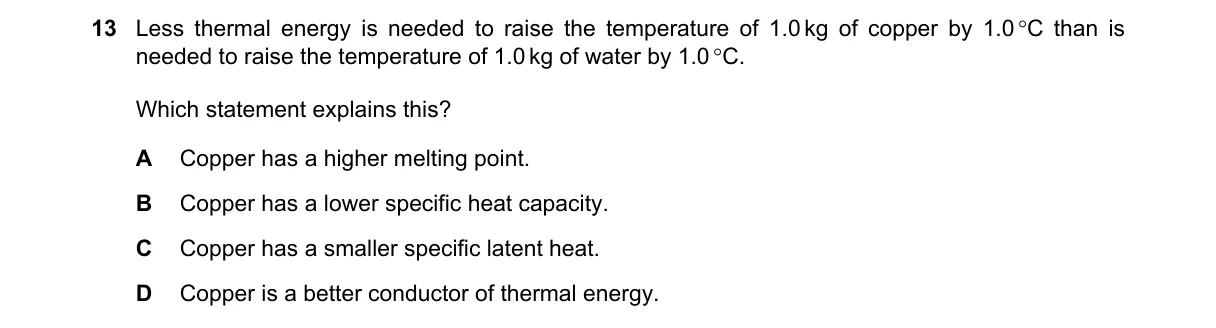
Answer choices
- ACopper has higher melting point
- BCopper has lower specific heat capacity
- CCopper has smaller specific latent heat
- DCopper is better conductor of thermal energy
Explanation
Specific heat capacity explains energy for temperature change
Steps:
- Thermal energy for temperature rise is Q = mcΔT, where m is mass, c is specific heat capacity, and ΔT is temperature change.
- For same m (1.0 kg) and ΔT (1°C), Q depends directly on c.
- Lower c means less Q needed.
- Copper's c (385 J/kg°C) is lower than water's (4186 J/kg°C), so less energy for copper.
Why B is correct:
- Specific heat capacity is energy per unit mass per degree change; lower value for copper means less energy required, per Q = mcΔT.
Why the others are wrong:
- A: Melting point relates to phase change, not temperature rise in solid state.
- C: Specific latent heat is for phase changes, irrelevant to temperature increase without melting.
- D: Conductivity affects heat transfer speed, not total energy to raise temperature.
Final answer: B
Topic: Specific heat capacity
Practice more O Levels/IGCSE Physics (5054) questions on mMCQ.me