O Levels/IGCSE Physics (5054)•5054/12/O/N/20
O Levels/IGCSE Physics (5054) — 5054/12/O/N/20, Question 12
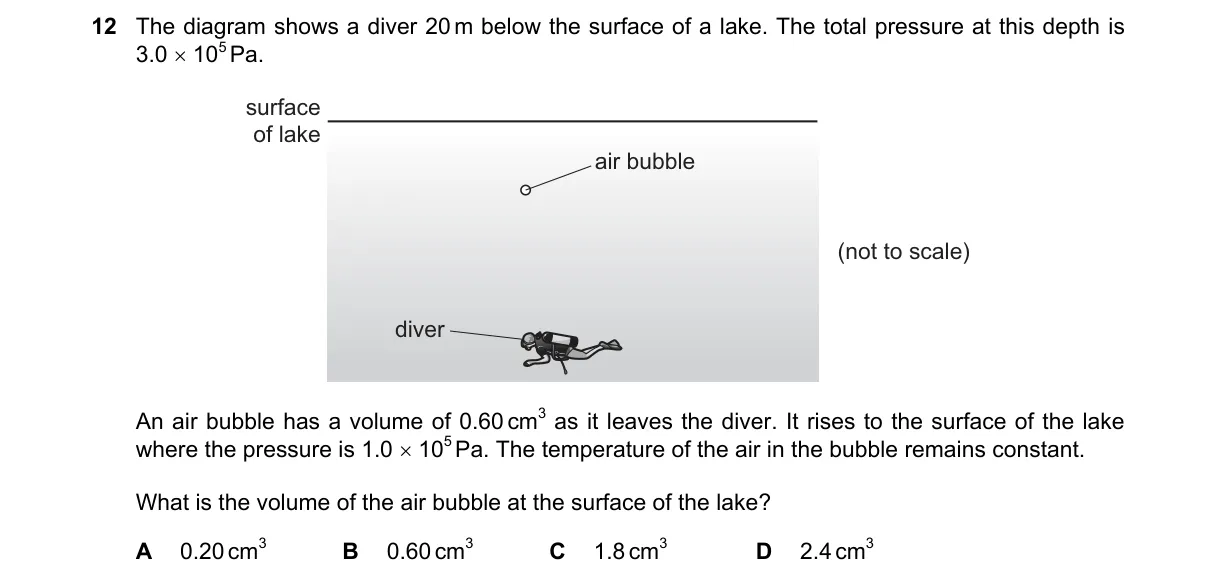
The diagram shows a diver 20 m below the surface of a lake. The total pressure at depth is 3.0 × 10^5 Pa. An air bubble has a volume of 0.60 cm³ as it leaves the diver. It rises to the surface of the lake where the pressure is 1.0 × 10^5 Pa. The temperature of the air in the bubble remains constant. What is the volume of the air bubble at the surface of the lake?
Answer choices
- A0.20 cm³
- B0.60 cm³
- C1.8 cm³
- D2.4 cm³
Explanation
Boyle's Law Applies (P1V1 = P2V2 at Constant T)
Steps:
- Apply Boyle's law: initial pressure P1 = 3.0 × 10^5 Pa, initial volume V1 = 0.60 cm³; final pressure P2 = 1.0 × 10^5 Pa.
- Rearrange for final volume: V2 = (P1 × V1) / P2.
- Substitute values: V2 = (3.0 × 10^5 × 0.60) / (1.0 × 10^5) = 1.8 × 10^5 / 10^5 = 1.8 cm³.
Why C is correct:
- 1.8 cm³ exactly matches the Boyle's law calculation for volume expansion due to pressure decrease.
Why the others are wrong:
- A: 0.20 cm³ assumes compression (reversed pressures), opposite of expansion.
- B: 0.60 cm³ ignores pressure change, assuming constant volume.
- D: 2.4 cm³ from incorrect ratio (e.g., 4:1 instead of 3:1).
Final answer: C
Topic: Pressure
Practice more O Levels/IGCSE Physics (5054) questions on mMCQ.me