O Levels/IGCSE Physics (5054)•5054/11/O/N/20
O Levels/IGCSE Physics (5054) — 5054/11/O/N/20, Question 23
Which statement about the melting of ice and the boiling of water is correct?
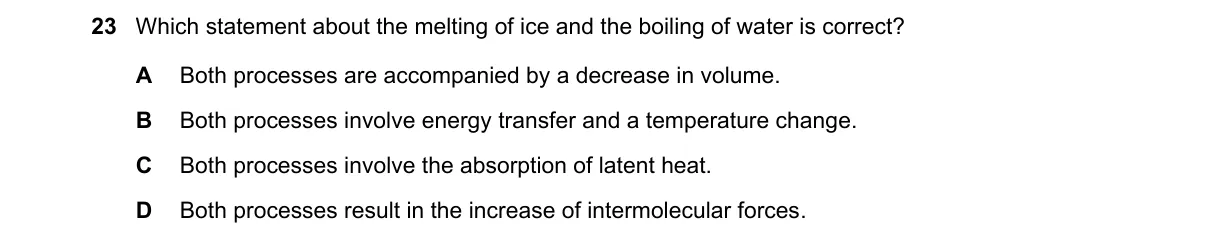
Answer choices
- ABoth processes are accompanied by a decrease in volume.
- BBoth processes involve energy transfer and a temperature change.
- CBoth processes involve the absorption of latent heat.
- DBoth processes result in increase of intermolecular forces.
Explanation
Latent Heat in Phase Changes
Steps:
- Recall that melting ice (solid to liquid) and boiling water (liquid to gas) are phase transitions requiring energy input.
- Identify that energy for these changes is latent heat, absorbed without temperature rise.
- Evaluate options: A checks volume changes, B checks temperature effects, C checks heat absorption, D checks forces.
- Select C as it matches the defining feature of both processes.
Why C is correct:
- Latent heat is the energy absorbed during phase changes to overcome intermolecular forces, as defined in thermodynamics, without altering temperature.
Why the others are wrong:
- A: Melting ice decreases volume slightly, but boiling increases it dramatically.
- B: Energy transfer occurs, but temperature remains constant during the phase change.
- D: Both processes weaken intermolecular forces, increasing molecular disorder.
Final answer: C
Topic: Melting, boiling and evaporation
Practice more O Levels/IGCSE Physics (5054) questions on mMCQ.me