O Levels/IGCSE Physics (5054)•5054/11/O/N/19
O Levels/IGCSE Physics (5054) — 5054/11/O/N/19, Question 26
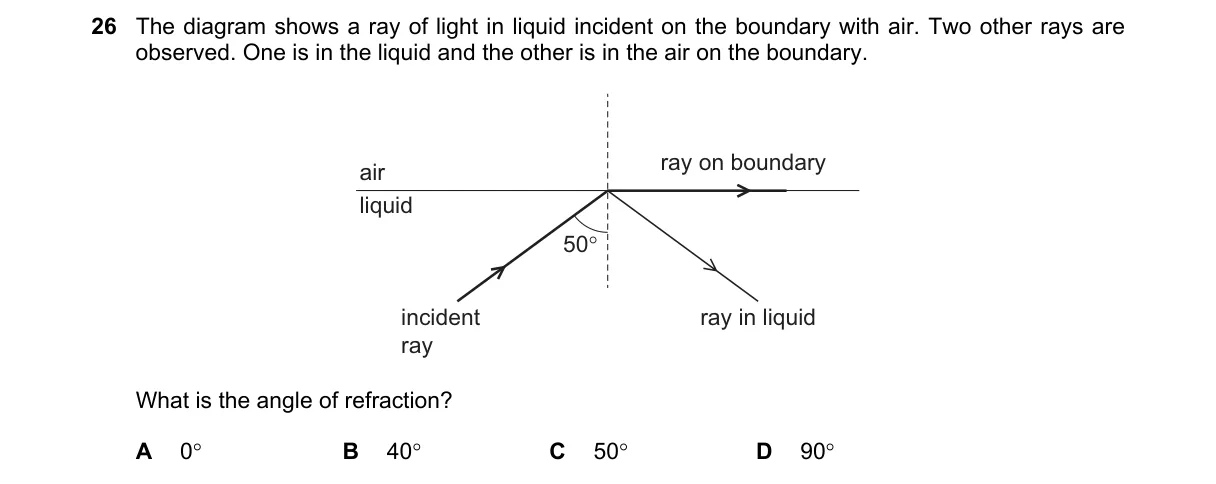
The diagram shows a ray of light in liquid incident on the boundary with air. Two other rays are observed. One is in the liquid and the other in air on the boundary with. What is the angle of
Answer choices
- A0°
- B40°
- C50°
- D90°
Explanation
Critical angle in refraction at liquid-air boundary
Steps:
- Identify the incident ray from liquid (denser medium) to air (rarer medium).
- Note the refracted ray in air along the boundary, indicating 90° angle of refraction.
- Apply Snell's law: n_liquid * sin(i) = n_air * sin(r), where r = 90°, sin(90°) = 1.
- Thus, sin(i) = 1 / n_liquid, so i is the critical angle, and r = 90°.
Why D is correct:
- By definition, at the critical angle of incidence, the refracted ray in air grazes the boundary at 90° (Snell's law with sin(r) = 1).
Why the others are wrong:
- A: 0° would mean normal incidence with no bending, not matching boundary grazing.
- B: 40° is a typical refraction angle but not for grazing emergence.
- C: 50° exceeds critical angle for most liquids, causing total internal reflection instead.
Final answer: D
Topic: Refraction of light
Practice more O Levels/IGCSE Physics (5054) questions on mMCQ.me