O Levels/IGCSE Physics (5054)•5054/11/O/N/19
O Levels/IGCSE Physics (5054) — 5054/11/O/N/19, Question 23
The diagram shows a glass flask of water at 10°C. A long tube passes through the bung into the flask. The water level in the tube is at X. The flask is placed in hot water and the water level in the tube eventually rises to Y. Why does the water level rise?
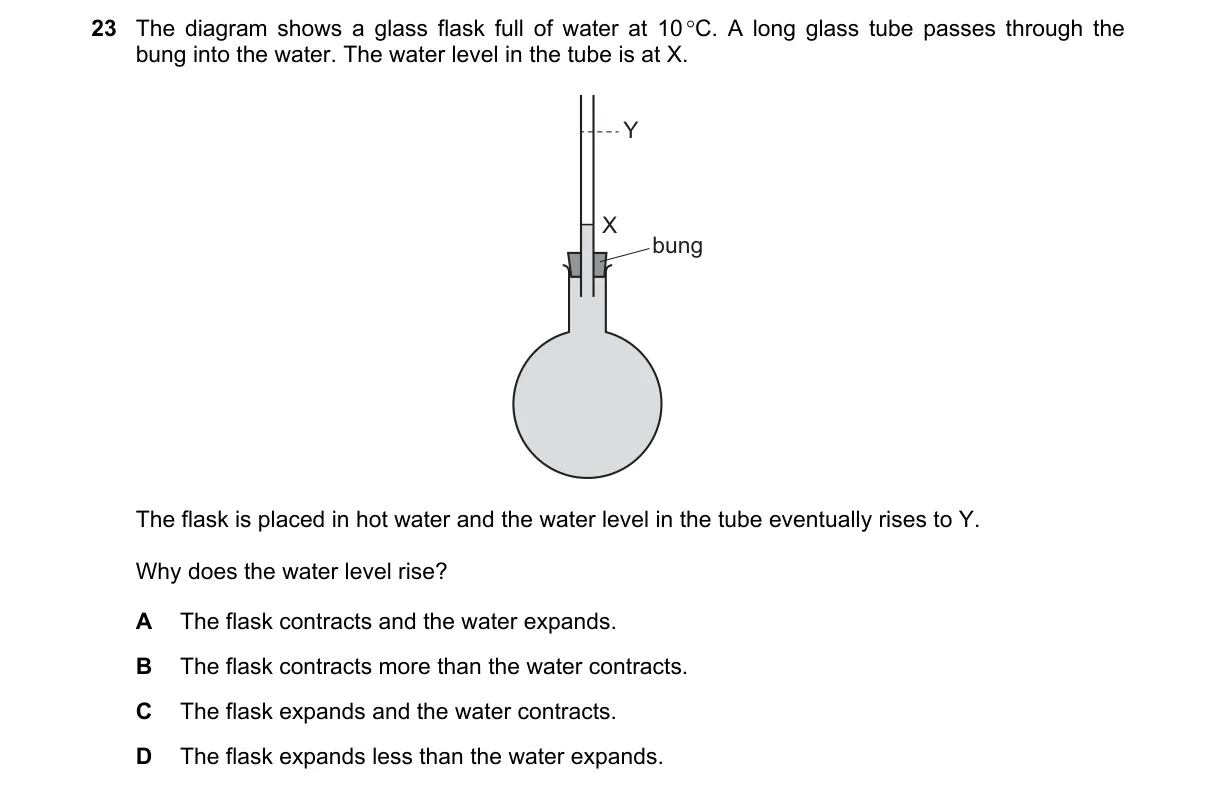
Answer choices
- AThe flask contracts and the water expands.
- BThe flask contracts more than the water contracts.
- CThe flask expands less than the water expands.
- DOption D
Explanation
Differential thermal expansion Steps:
- The flask and water are heated to a higher temperature.
- Both the glass flask and water expand due to thermal expansion.
- Water has a greater coefficient of volume expansion than glass.
- The water's volume increase exceeds the flask's, forcing water up the tube to Y.
Why D is correct:
- D states the water expands more than the flask; this follows from the volume expansion formula ΔV = V₀ β ΔT, where β_water (2.1 × 10⁻⁴/°C) > β_glass (≈ 2.7 × 10⁻⁵/°C).
Why the others are wrong:
- A: Glass expands on heating, it does not contract.
- B: Neither contracts on heating; both expand.
- C: This describes expansion but ignores the flask's expansion relative to water's greater expansion.
Final answer: D
Topic: Thermal expansion of solids, liquids and gases
Practice more O Levels/IGCSE Physics (5054) questions on mMCQ.me