O Levels/IGCSE Physics (5054)•5054/11/O/N/19
O Levels/IGCSE Physics (5054) — 5054/11/O/N/19, Question 15
Which quantities from the list are used to calculate the total pressure at the bottom of a lake?
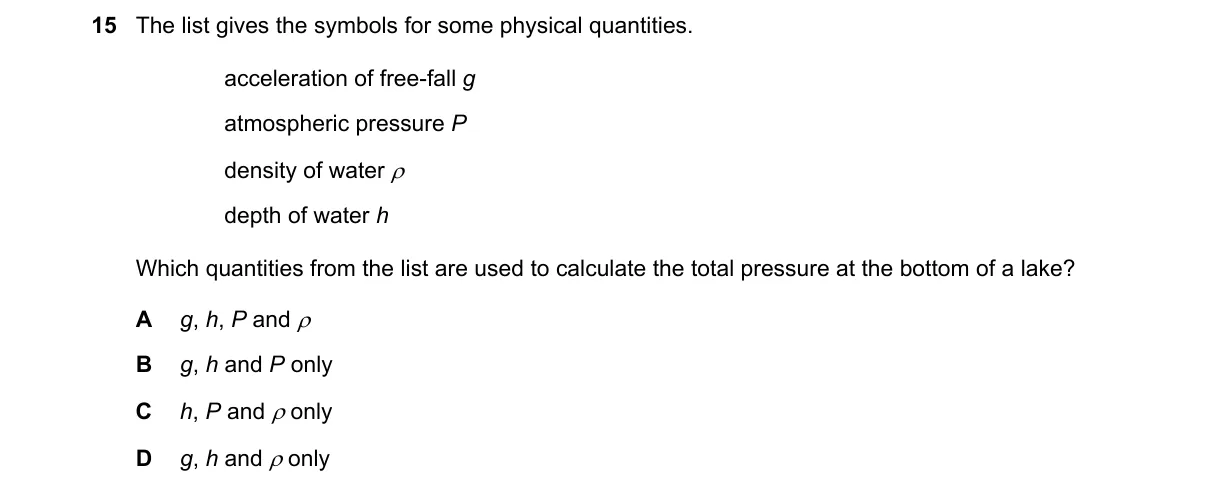
Answer choices
- Ag, ρ and p
- Bg, h and P only
- Cρ, h and P only
- Dρ and h only
Explanation
Hydrostatic Pressure in Fluids
Steps:
- Total pressure at lake bottom combines atmospheric pressure and hydrostatic pressure from water.
- Hydrostatic pressure is ρ g h, where ρ is water density, g is gravity, and h is depth.
- Atmospheric pressure is denoted as p (or P).
- Thus, total pressure formula is p + ρ g h, requiring g, ρ, and p.
Why A is correct:
- Matches the formula P_total = p + ρ g h, where p is atmospheric pressure, ρ is density, and g is gravitational acceleration.
Why the others are wrong:
- B omits ρ (density), essential for hydrostatic component.
- C omits g (gravity), needed to compute weight of fluid column.
- D omits p (atmospheric pressure), ignoring surface pressure contribution.
Final answer: A
Topic: Pressure
Practice more O Levels/IGCSE Physics (5054) questions on mMCQ.me