O Levels/IGCSE Physics (5054)•5054/11/O/N/19
O Levels/IGCSE Physics (5054) — 5054/11/O/N/19, Question 13
A load L is suspended from two springs that are in parallel. The extension of each spring is x. The springs are then arranged to hang vertically, one below the other. In this new arrangement, what is the total extension of the two springs?
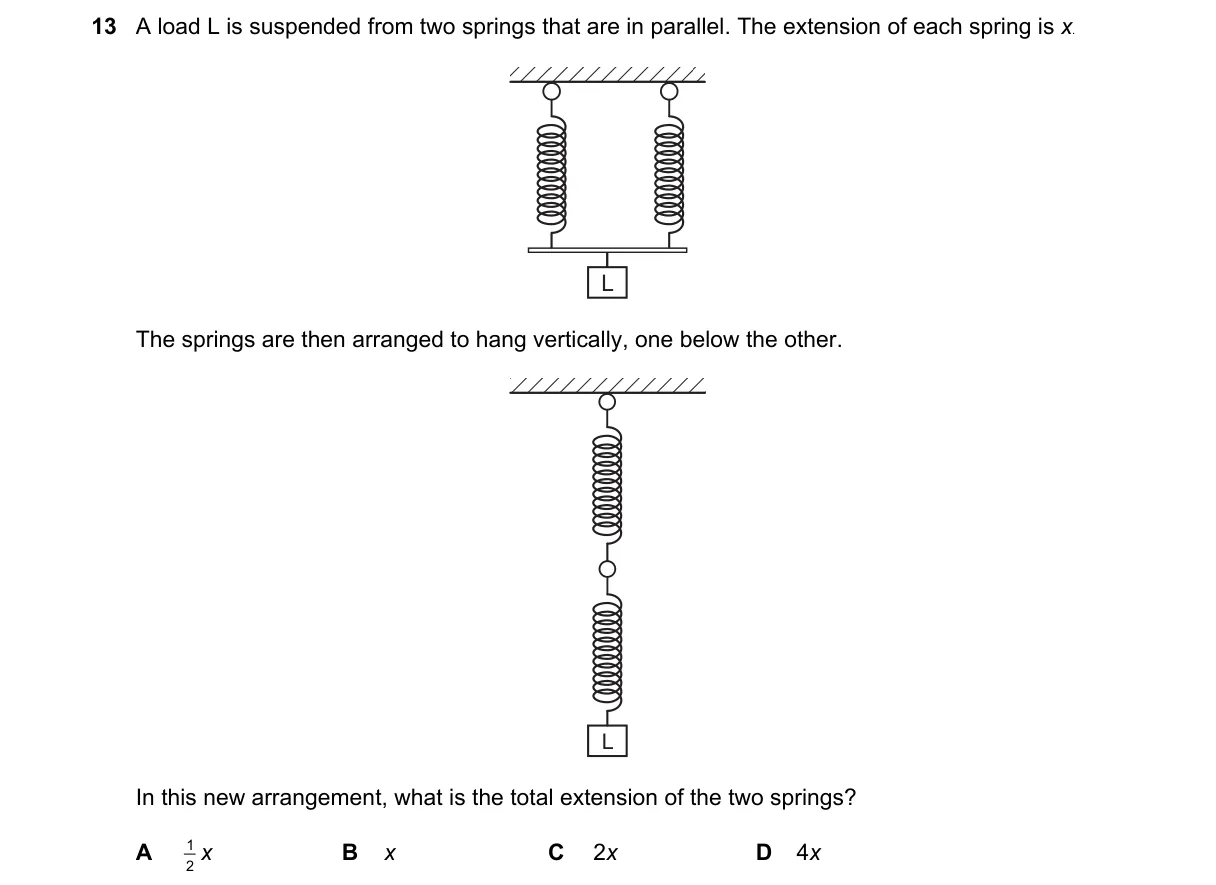
Answer choices
- Ax/2
- Bx
- C2x
- D4x
Explanation
Series vs. parallel spring extensions
Steps:
- In parallel, load L is shared equally; each spring bears L/2 and extends by x, so spring constant k = (L/2)/x = L/(2x).
- In series, springs connect end-to-end; effective spring constant k_eff = k/2 for identical springs.
- Total extension in series is δ = L / k_eff = L / (k/2) = 2L/k.
- Substitute k = L/(2x) to get δ = 2L / (L/(2x)) = 2 * 2x = 4x.
Why D is correct:
- Hooke's law for series combination: total extension doubles for each spring's individual extension under full load, yielding 4x from parallel baseline.
Why the others are wrong:
- A: x/2 ignores load redistribution, underestimating series extension.
- B: x assumes parallel extension persists, neglecting series weakening.
- C: 2x matches single-spring doubling but misses parallel's halved force per spring.
Final answer: D
Topic: Elastic deformation
Practice more O Levels/IGCSE Physics (5054) questions on mMCQ.me