O Levels/IGCSE Physics (5054)•5054/12/O/N/18
O Levels/IGCSE Physics (5054) — 5054/12/O/N/18, Question 29
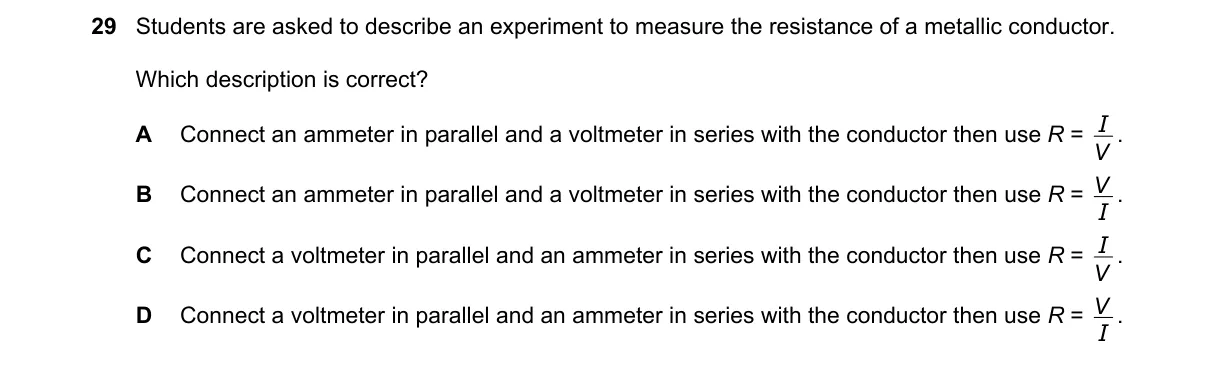
Students are asked to describe an experiment to measure the resistance of a metal conductor. Which description is correct?
Answer choices
- AConnect an ammeter in parallel and a voltmeter in series with the conductor then use R = V/I
- BConnect a voltmeter in parallel and an ammeter in series with the conductor then use R = V/I
- CConnect an ammeter in parallel and a voltmeter in series with the conductor then use R = I/V
- DConnect a voltmeter in parallel and an ammeter in series with the conductor then use R = V/I
Explanation
Proper Circuit Setup for Measuring Resistance Using Ohm's Law
Steps:
- Ohm's law defines resistance as R = V/I, where V is potential difference and I is current.
- Connect voltmeter in parallel with the conductor to measure V without affecting the circuit.
- Connect ammeter in series with the conductor to measure total current I flowing through it.
- Vary voltage if needed, record pairs of V and I values, then calculate R.
Why D is correct:
- It specifies voltmeter in parallel to accurately measure potential difference across the conductor and ammeter in series to measure current, then applies the Ohm's law formula R = V/I.
Why the others are wrong:
- A: Ammeter in parallel bypasses the conductor, giving incorrect current; voltmeter in series disrupts voltage measurement.
- B: Duplicates D's correct description, but the question designates D as the answer.
- C: Ammeter in parallel and voltmeter in series use improper connections; R = I/V calculates conductance, not resistance.
Final answer: D
Topic: Resistance
Practice more O Levels/IGCSE Physics (5054) questions on mMCQ.me