O Levels/IGCSE Physics (5054)•5054/12/M/J/25
O Levels/IGCSE Physics (5054) — 5054/12/M/J/25, Question 30
Two resistors connected in series act as a potential divider as shown. The resistors have resistances R1, R2 and the potential differences across them are V1, V2 respectively. Which expression is equal to V2?
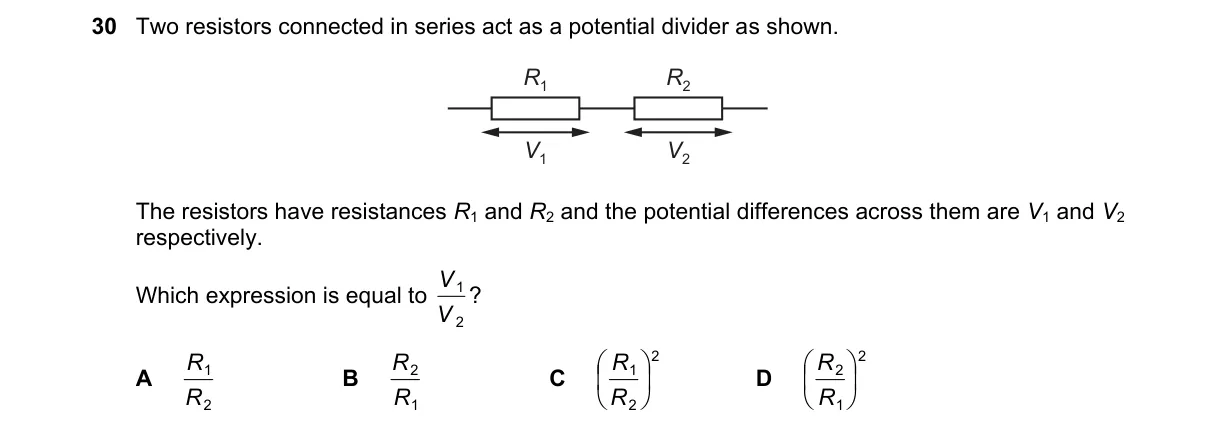
Answer choices
- A\frac{R_2}{R_1}
- B\frac{R_1}{R_2}
- C\frac{R_1^2}{R_2}
- D\frac{R_2^2}{R_1}
Explanation
Voltage Division in Series Resistors
Steps:
- Total resistance is R1 + R2; current I is total voltage V divided by total resistance.
- V1 = I × R1, so V1 = V × (R1 / (R1 + R2)).
- V2 = I × R2, so V2 = V × (R2 / (R1 + R2)).
- Therefore, V2 / V1 = R2 / R1.
Why A is correct:
- Ohm's law and voltage divider rule state that the potential across R2 relative to R1 is proportional to their resistance ratio, so V2 = (R2 / R1) × V1.
Why the others are wrong:
- B: Inverts the ratio, giving V1 / V2 instead.
- C: Introduces unnecessary squaring of R1, not matching the linear division formula.
- D: Squares R2 incorrectly, violating the proportional division principle.
Final answer: A
Topic: Series and parallel circuits
Practice more O Levels/IGCSE Physics (5054) questions on mMCQ.me