O Levels/IGCSE Physics (5054)•5054/12/M/J/25
O Levels/IGCSE Physics (5054) — 5054/12/M/J/25, Question 3
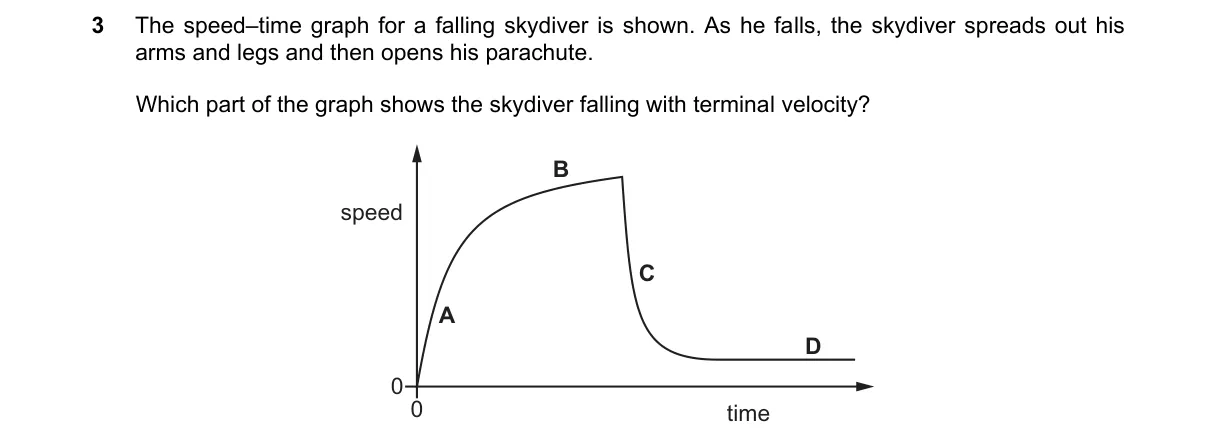
The speed-time graph for a falling skydiver is shown. As he falls, the skydiver spreads out his arms and legs and then opens his parachute. Which part of the graph shows the skydiver falling with terminal velocity?
Answer choices
- AOption A
- BOption B
- COption C
- DOption D
Explanation
Terminal velocity as constant speed on graph Steps:
- Terminal velocity is reached when drag equals weight, causing zero acceleration and constant speed.
- On a speed-time graph, this shows as a horizontal line segment.
- Skydiver accelerates initially, reaches first terminal velocity after spreading limbs, then decelerates upon parachute opening to a lower terminal velocity.
- The final horizontal line after parachute indicates the new terminal velocity.
Why D is correct:
- D is the horizontal line after parachute deployment, where increased drag balances weight for constant lower speed (Newton's first law: net force zero).
Why the others are wrong:
- A: Steep upward slope shows initial acceleration due to gravity exceeding drag.
- B: Horizontal line before parachute shows first (higher) terminal velocity, not after opening.
- C: Downward slope shows deceleration from excess drag after parachute.
Final answer: D
Topic: Motion
Practice more O Levels/IGCSE Physics (5054) questions on mMCQ.me