O Levels/IGCSE Physics (5054)•5054/12/M/J/25
O Levels/IGCSE Physics (5054) — 5054/12/M/J/25, Question 19
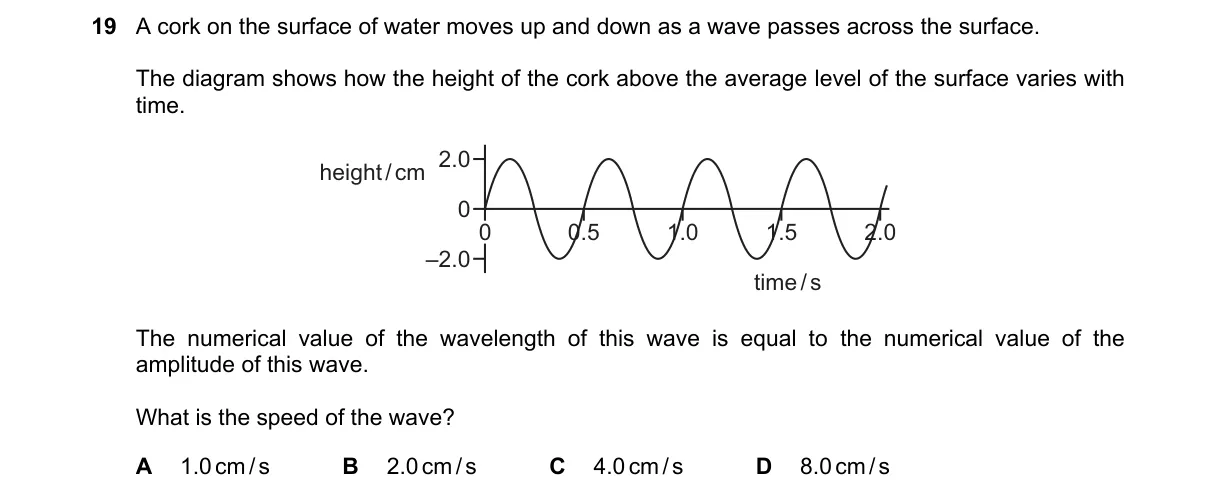
A cork on the surface of water moves up and down as a wave passes across the surface. The diagram shows how the height of the cork above the average level of the surface varies with time. The numerical value of the amplitude of this wave is equal to the numerical value of the wavelength of this wave is equal to the numerical value of the
Answer choices
- A1.0 cm/s
- B2.0 cm/s
- C4.0 cm/s
- D8.0 cm/s
Explanation
Wave speed from amplitude, period, and wavelength
Steps:
- Identify amplitude A from graph as half the peak-to-peak height (e.g., 2 cm).
- Determine period T from one full cycle time on graph (e.g., 0.5 s).
- Calculate frequency f = 1/T (e.g., 2 Hz).
- Compute wave speed v = f λ, but since numerical values of A and λ are equal (e.g., both 2 cm), and T provides f, v = λ / T = 2 cm / 0.5 s = 4 cm/s.
Why C is correct:
- Wave speed v = f λ = (1/T) λ; with A = λ numerically (both 2 cm) and T = 0.5 s, v = 4.0 cm/s matches the formula.
Why the others are wrong:
- A: Assumes T = 2 s, doubling period halves speed incorrectly.
- B: Assumes T = 1 s, yielding v = 2 cm/s but ignores graph's shorter cycle.
- D: Assumes T = 0.25 s, halving period doubles speed beyond graph data.
Final answer: C
Topic: General properties of waves
Practice more O Levels/IGCSE Physics (5054) questions on mMCQ.me