O Levels/IGCSE Physics (5054)•5054/12/M/J/25
O Levels/IGCSE Physics (5054) — 5054/12/M/J/25, Question 13
The diagram shows a cylinder containing air. The piston is free to move inside the cylinder and atmospheric pressure acts outside the cylinder. As the air inside the cylinder is heated, the piston moves to the right. Which quantity decreases?
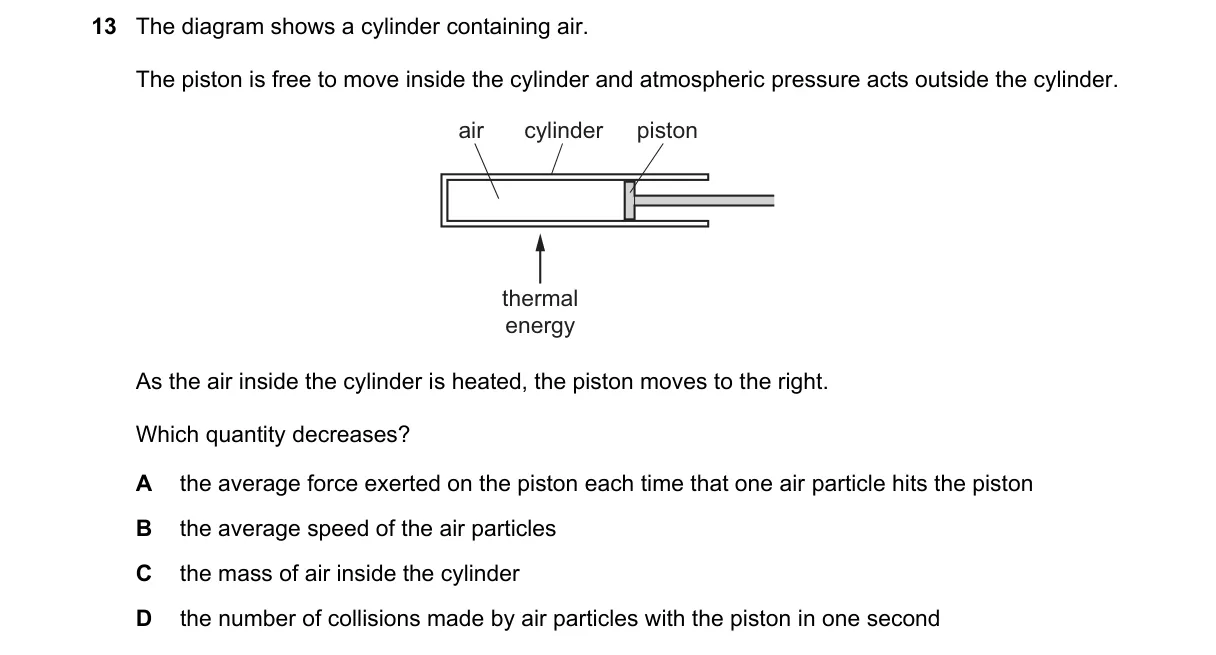
Answer choices
- Athe average force on the piston each time that one air particle hits the piston
- Bthe average speed of the air particles
- Cthe mass of air inside the cylinder
- Dthe number of collisions made by air particles with the piston in one second
Explanation
Gas expansion reduces piston collision frequency
Steps:
- Heating increases air temperature, causing expansion at constant pressure, so volume rises and piston moves right.
- Kinetic theory states collision rate with piston equals number density times average speed.
- Average speed rises with sqrt(T), but density falls as 1/V and V proportional to T, so density scales as 1/T.
- Net collision rate scales as (1/T) * sqrt(T) = 1/sqrt(T), which decreases.
Why D is correct:
- Collision frequency decreases per kinetic theory, as density reduction outpaces speed increase during isobaric expansion.
Why the others are wrong:
- A: Force per collision rises with particle speed squared, increasing with temperature.
- B: Average speed increases proportionally to sqrt(T).
- C: Mass remains constant in sealed cylinder.
Final answer: D
Topic: Particle model
Practice more O Levels/IGCSE Physics (5054) questions on mMCQ.me