O Levels/IGCSE Physics (5054)•5054/12/M/J/25
O Levels/IGCSE Physics (5054) — 5054/12/M/J/25, Question 11
A hammer hits a nail into a piece of wood. The weight of the nail is negligible. The hammer exerts a force F_h and a pressure p_h on the nail. The nail exerts a force F_n and a pressure p_n on the wood. How do these forces and pressures compare?
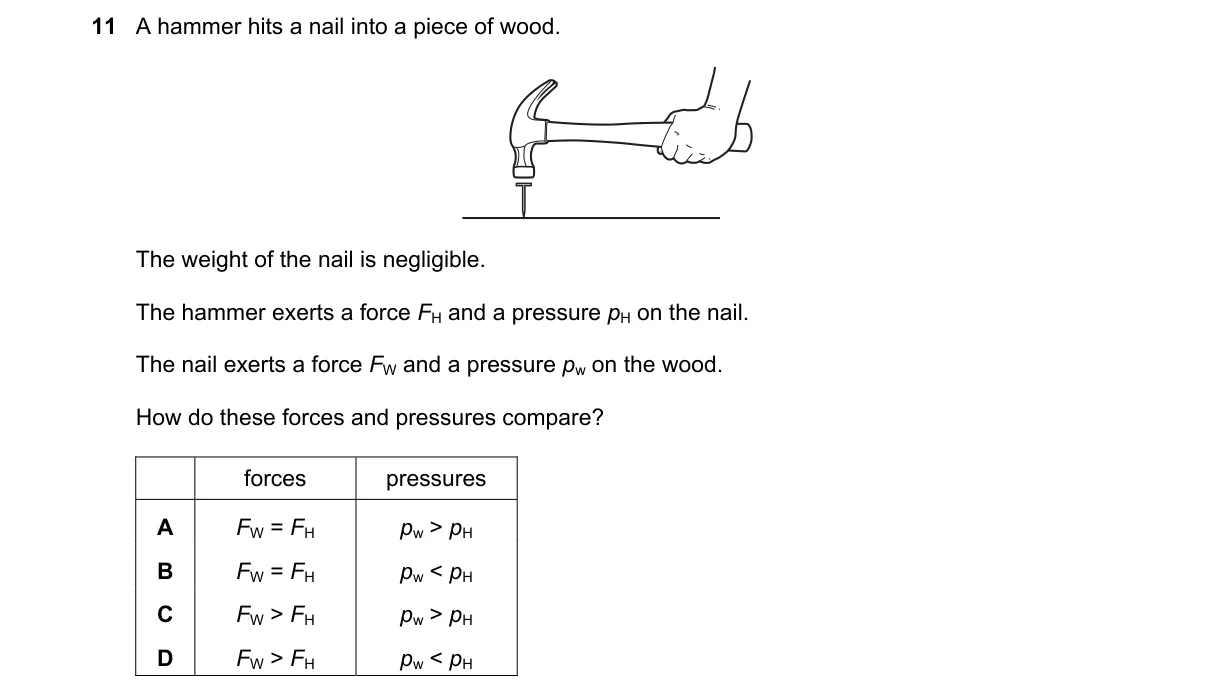
Answer choices
- AF_h > F_n, p_h > p_n
- BF_h = F_n, p_h > p_n
- CF_h > F_n, p_h = p_n
- DF_h = F_n, p_h < p_n
Explanation
Newton's Third Law and Pressure Definition
Steps:
- Hammer applies force F_h to nail; by action-reaction, nail applies equal force back to hammer.
- Nail applies force F_n to wood; with negligible nail mass, net force on nail is zero, so F_h = F_n.
- Pressure p = force / contact area.
- Hammer-nail contact area (nail head) is larger than nail-wood contact area (nail tip), so p_h < p_n.
Why D is correct:
- Negligible mass implies F_h = F_n (Newton's second law, net force ≈ 0); p_h < p_n since p = F/A and A_h > A_n (pressure formula).
Why the others are wrong:
- A: F_h = F_n (not >); p_h < p_n (not >).
- B: p_h < p_n (not >).
- C: F_h = F_n (not >); p_h ≠ p_n.
Final answer: D
Topic: Pressure
Practice more O Levels/IGCSE Physics (5054) questions on mMCQ.me