O Levels/IGCSE Physics (5054)•5054/11/M/J/25
O Levels/IGCSE Physics (5054) — 5054/11/M/J/25, Question 36
A radioactive nucleus X decays to another radioactive nucleus. After a number of decays, a stable nucleus Q is produced. The proton number (atomic number) of X is equal to that of Q. The nucleon number (mass number) of X is four more than that of Q. Which radiation is emitted to produce Q?
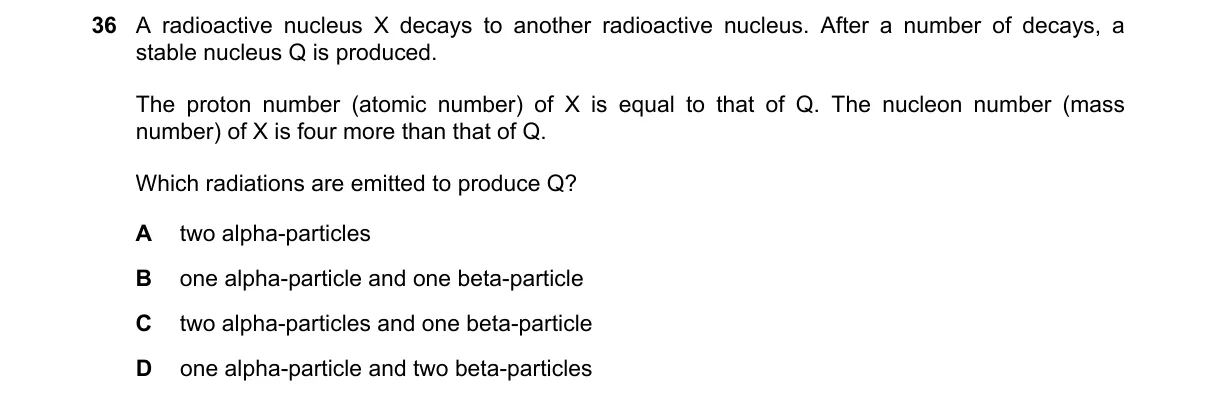
Answer choices
- Atwo alpha particles and one beta particle
- Bone alpha particle and one beta particle
- Cone alpha particle and two beta particles
- Dtwo alpha particles and one beta particle
Explanation
Net changes in mass and atomic numbers from decay emissions
Steps:
- Alpha emission reduces mass number (A) by 4 and atomic number (Z) by 2 per particle.
- Beta-minus emission keeps A unchanged but increases Z by 1 per particle.
- Required net changes: ΔA = -4 (X loses 4 nucleons), ΔZ = 0 (same protons).
- Test combinations: one alpha gives ΔA = -4, ΔZ = -2; adding two betas gives ΔZ = +2, netting ΔA = -4, ΔZ = 0.
Why C is correct:
- Matches conservation laws: one alpha accounts for ΔA = -4 and ΔZ = -2; two betas compensate with ΔZ = +2, yielding exact net changes.
Why the others are wrong:
- A: Two alphas and one beta yield ΔA = -8, ΔZ = -3 (excess mass loss, wrong Z).
- B: One alpha and one beta yield ΔA = -4, ΔZ = -1 (correct A but insufficient Z increase).
- D: Identical to A, yields ΔA = -8, ΔZ = -3 (excess mass loss, wrong Z).
Final answer: C
Topic: Radioactive decay
Practice more O Levels/IGCSE Physics (5054) questions on mMCQ.me