O Levels/IGCSE Physics (5054)•5054/11/M/J/25
O Levels/IGCSE Physics (5054) — 5054/11/M/J/25, Question 3
Which statement explains why a heavy coin that falls through a short distance towards the ground does not reach terminal velocity?
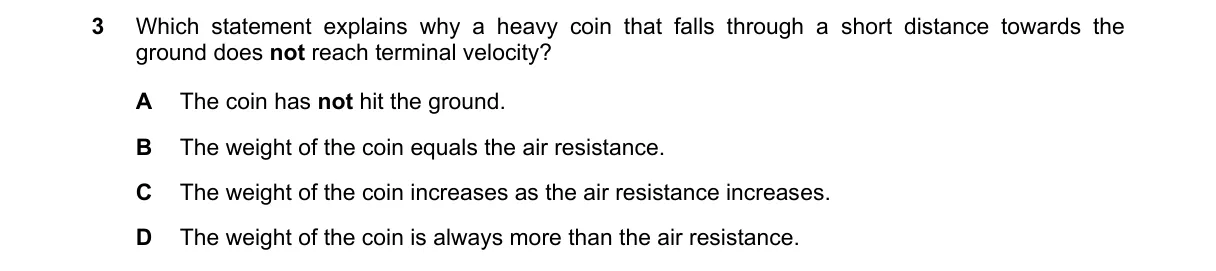
Answer choices
- AThe coin has not hit the ground.
- BThe weight of the coin is less than the air resistance.
- CThe weight of the coin equals the air resistance.
- DThe weight of the coin is always more than the air resistance.
Explanation
Terminal velocity requires balanced forces over sufficient time
Steps:
- Terminal velocity occurs when gravitational force (weight) equals drag force from air resistance, resulting in zero net force and constant speed.
- Air resistance increases with the square of velocity, starting low and building as the object accelerates.
- For a heavy coin, weight is large, so high speed is needed for air resistance to match it.
- Over a short distance, acceleration time is too brief for velocity to reach the point where forces balance.
Why D is correct:
- Newton's second law shows net force = weight - air resistance; for a heavy coin over short distance, weight exceeds air resistance (F_net > 0), so acceleration continues without reaching terminal velocity.
Why the others are wrong:
- A: Hitting the ground is unrelated; failure to reach terminal velocity depends on distance fallen, not impact.
- B: A heavy coin has weight greater than initial air resistance, causing acceleration.
- C: Equal forces define terminal velocity, which the coin does not achieve.
Final answer: D
Topic: Balanced and unbalanced forces
Practice more O Levels/IGCSE Physics (5054) questions on mMCQ.me