O Levels/IGCSE Physics (5054)•5054/11/M/J/25
O Levels/IGCSE Physics (5054) — 5054/11/M/J/25, Question 17
A sample of water in a beaker is at a temperature T. The surface area of the water is A and an electric fan blows air over the top of the beaker at speed v. For which values of T, A and v does the water evaporate most rapidly?
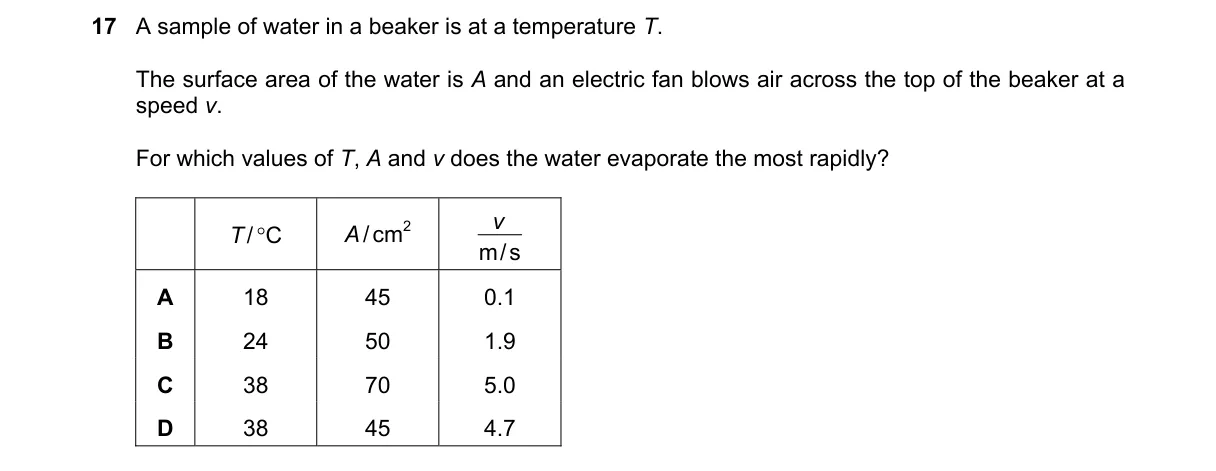
Answer choices
- AT = 18 °C, A = 45 cm², v = 0.1 m s⁻¹
- BT = 24 °C, A = 50 cm², v = 1.9 m s⁻¹
- CT = 28 °C, A = 70 cm², v = 5.0 m s⁻¹
- DT = 38 °C, A = 45 cm², v = 4.7 m s⁻¹
Explanation
Evaporation rate increases with temperature, surface area, and air speed
Steps:
- Higher temperature increases vapor pressure, accelerating evaporation.
- Larger surface area exposes more water molecules to air.
- Faster air speed removes humid boundary layer, sustaining evaporation.
- Compare options: C has the largest A (70 cm²) and highest v (5.0 m/s), with T (28°C) higher than A and B but lower than D; overall, C maximizes combined factors.
Why C is correct:
- C optimizes all variables per Dalton's law of evaporation, where rate ∝ (vapor pressure difference) × A × (1 + wind factor), yielding highest net rate.
Why the others are wrong:
- A: Lowest T and v limit vapor pressure and air renewal despite moderate A.
- B: Moderate values across all, but smaller A and lower v than C reduce rate.
- D: Highest T, but smallest A and near-high v cannot compensate for reduced exposure area.
Final answer: C
Topic: Melting, boiling and evaporation
Practice more O Levels/IGCSE Physics (5054) questions on mMCQ.me