O Levels/IGCSE Physics (5054)•5054/11/M/J/25
O Levels/IGCSE Physics (5054) — 5054/11/M/J/25, Question 16
When a liquid evaporates, which molecules escape, and what happens to the average kinetic energy of the molecules remaining in the liquid?
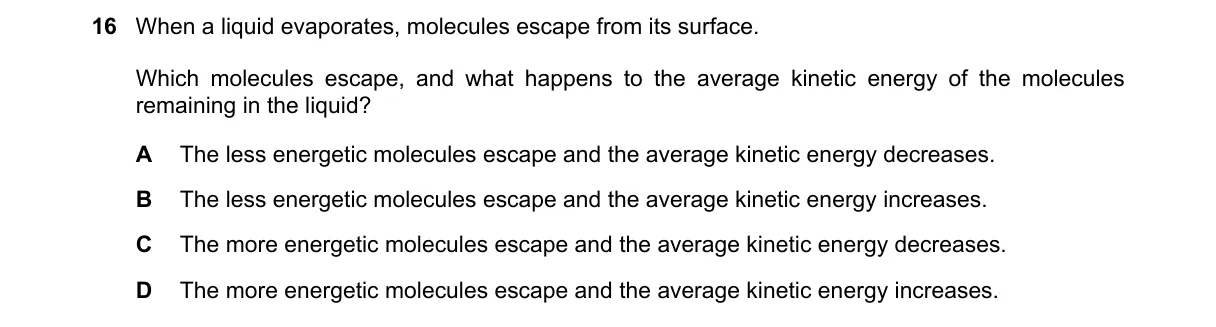
Answer choices
- AThe less energetic molecules escape and the average kinetic energy decreases.
- BThe less energetic molecules escape and the average kinetic energy increases.
- CThe more energetic molecules escape and the average kinetic energy decreases.
- DThe more energetic molecules escape and the average kinetic energy increases.
Explanation
Evaporation and Kinetic Energy Loss
Steps:
- Evaporation happens at the liquid surface where molecules must overcome intermolecular forces to escape as vapor.
- Molecules with higher kinetic energy have greater speed and are more likely to break free from the liquid.
- When these faster, more energetic molecules escape, they remove energy from the system.
- The remaining molecules thus have a lower average kinetic energy, cooling the liquid.
Why C is correct:
- According to the kinetic molecular theory, evaporation selectively removes high-KE molecules, reducing the average KE of those left behind, as KE is proportional to temperature (KE_avg = 3/2 kT).
Why the others are wrong:
- A: Less energetic molecules do not escape; higher KE ones do, so average KE decreases, not from low-KE loss.
- B: Less energetic molecules do not escape, so average KE does not increase.
- D: More energetic molecules escape, but this decreases average KE, not increases it.
Final answer: C
Topic: Melting, boiling and evaporation
Practice more O Levels/IGCSE Physics (5054) questions on mMCQ.me