O Levels/IGCSE Physics (5054)•5054/11/M/J/24
O Levels/IGCSE Physics (5054) — 5054/11/M/J/24, Question 3
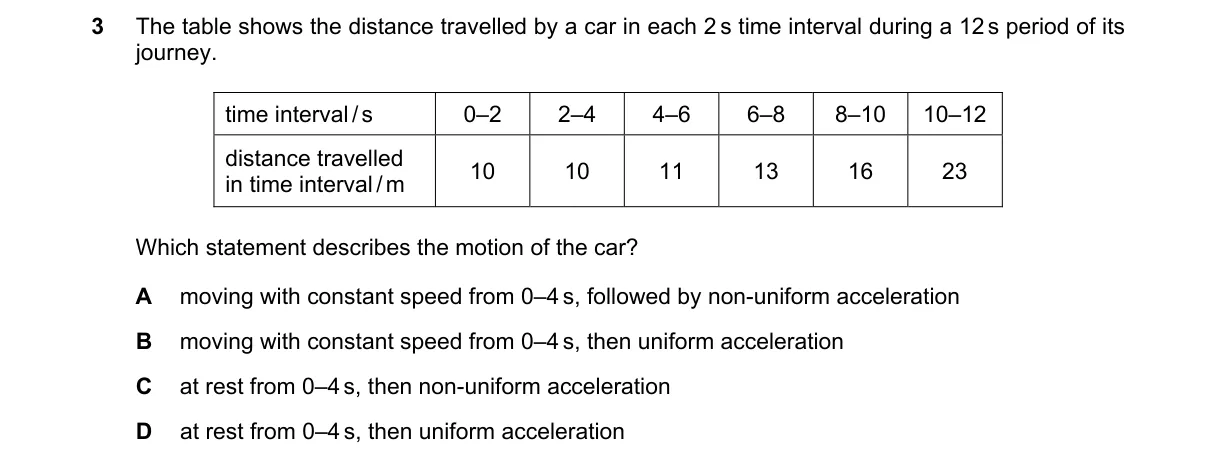
The table shows the distance travelled by a car in each 2s interval during a 12s period of its journey.
Time interval/s: 0-2, 2-4, 4-6, 6-8, 8-10, 10-12
Distance travelled in time interval/m: 10, 10, 11, 13, 16, 23
Answer choices
- Amoving with constant speed from 0-4s, then non-uniform acceleration
- Bmoving with constant speed from 0-4s, then uniform acceleration
- Cat rest from 0-4s, then non-uniform acceleration
- Dat rest from 0-4s, then uniform acceleration
Explanation
Determining motion from average speeds in intervals
Steps:
- Compute average speeds: 10m/2s=5 m/s (0-2s), 10m/2s=5 m/s (2-4s), 11m/2s=5.5 m/s (4-6s), 13m/2s=6.5 m/s (6-8s), 16m/2s=8 m/s (8-10s), 23m/2s=11.5 m/s (10-12s).
- From 0-4s, speeds are constant at 5 m/s, indicating constant speed.
- From 4-12s, speeds increase (5.5, 6.5, 8, 11.5 m/s), showing acceleration.
- Speed increments (0.5, 1.0, 1.5, 3.5 m/s) vary, confirming non-uniform acceleration.
Why A is correct:
- Equal distances in 0-4s intervals mean constant speed (distance = speed × time, with fixed time); unequal, increasing speed changes after 4s indicate non-uniform acceleration per kinematics definitions.
Why the others are wrong:
- B: Speed increments are unequal, not linear as required for uniform acceleration.
- C: Distances of 10m in 0-4s intervals mean motion, not rest (distance > 0).
- D: Not at rest in 0-4s, and acceleration is non-uniform.
Final answer: A
Topic: Motion
Practice more O Levels/IGCSE Physics (5054) questions on mMCQ.me