O Levels/IGCSE Physics (5054)•5054/12/M/J/23
O Levels/IGCSE Physics (5054) — 5054/12/M/J/23, Question 32
A coil of wire above a magnet is dropped. As the coil falls over the magnet, emf is induced. What does not affect the magnitude of emf?
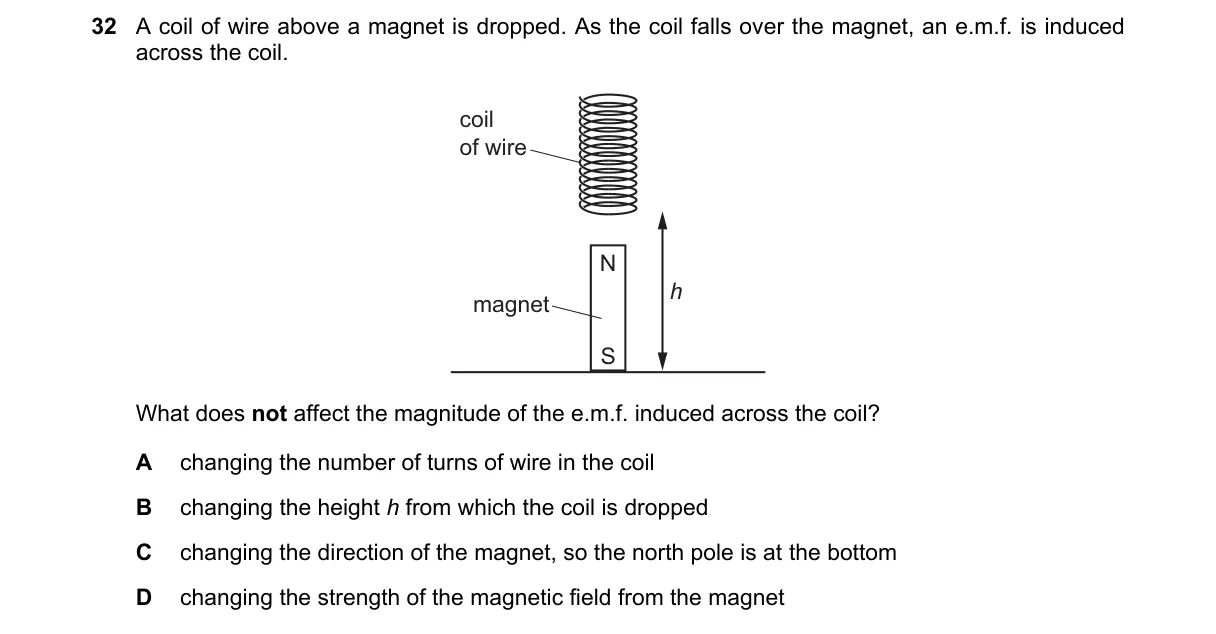
Answer choices
- Achanging the number of turns of the wire in the coil
- Bchanging the height h from which the coil is dropped
- Cchanging the direction of the magnetic field from the north pole at the bottom
- Dchanging the strength of the magnetic field from the magnet
Explanation
Faraday's Law of Electromagnetic Induction
Steps:
- Induced emf magnitude is given by ε = N |dΦ/dt|, where Φ = B ⋅ A (flux through coil area A).
- As coil falls, flux changes due to motion through magnetic field B, so dΦ/dt depends on speed v, B, and N.
- Speed v at magnet depends on drop height h via kinematics (v = √(2gh)).
- Field direction affects emf polarity (Lenz's law) but not |dΦ/dt| magnitude.
Why C is correct:
- Faraday's law shows emf magnitude depends on flux change rate, independent of B direction; reversal flips emf sign but preserves |ε|.
Why the others are wrong:
- A: More turns increases N, multiplying ε proportionally.
- B: Higher h boosts terminal speed, raising |dΦ/dt| and ε.
- D: Stronger B enlarges Φ, increasing |dΦ/dt| and ε.
Final answer: C
Topic: Electromagnetic induction
Practice more O Levels/IGCSE Physics (5054) questions on mMCQ.me