O Levels/IGCSE Physics (5054)•5054/12/M/J/23
O Levels/IGCSE Physics (5054) — 5054/12/M/J/23, Question 29
A student has three 5Ω resistors. She connects the three resistors in different arrangements. What is the minimum resistance and what is the maximum resistance of the arrangements that the student can produce
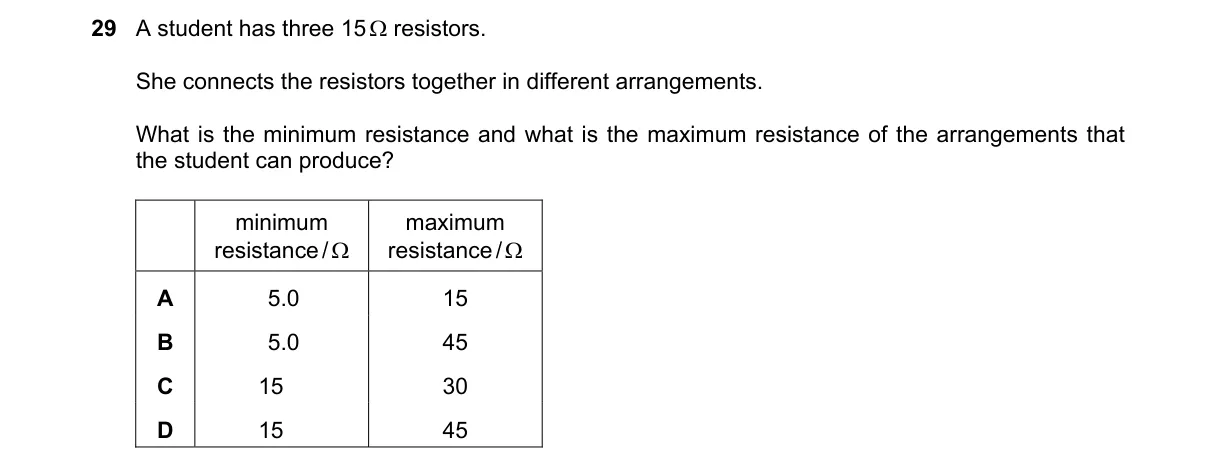
Answer choices
- A5.0 Ω 15 Ω
- B5.0 Ω 45 Ω
- C15 Ω 30 Ω
- D15 Ω 45 Ω
Explanation
Series and parallel resistor combinations Steps:
- Maximum resistance occurs when all three resistors are connected in series: total R = R + R + R = 3R.
- Minimum resistance occurs when all three are connected in parallel: 1/R_min = 1/R + 1/R + 1/R = 3/R, so R_min = R/3.
- For R = 15 Ω, maximum = 45 Ω and minimum = 5.0 Ω.
- Other arrangements (e.g., two in series with one in parallel) yield values between 5 Ω and 45 Ω.
Why B is correct:
- Option B matches the series formula (3R = 45 Ω) and parallel formula (R/3 = 5.0 Ω) for three equal resistors.
Why the others are wrong:
- A: Underestimates maximum (15 Ω is two in series, not all three).
- C: Swaps min/max and ignores parallel reduction to 5 Ω.
- D: Overestimates minimum (15 Ω is a single resistor, not using all three in parallel).
Final answer: B
Topic: Series and parallel circuits
Practice more O Levels/IGCSE Physics (5054) questions on mMCQ.me