O Levels/IGCSE Physics (5054)•5054/11/M/J/23
O Levels/IGCSE Physics (5054) — 5054/11/M/J/23, Question 37
The diagram shows how the thickness of paper is measured during manufacture. If the sheet is too thick, fewer beta particles can reach the detector. Why are beta particles used for this purpose?
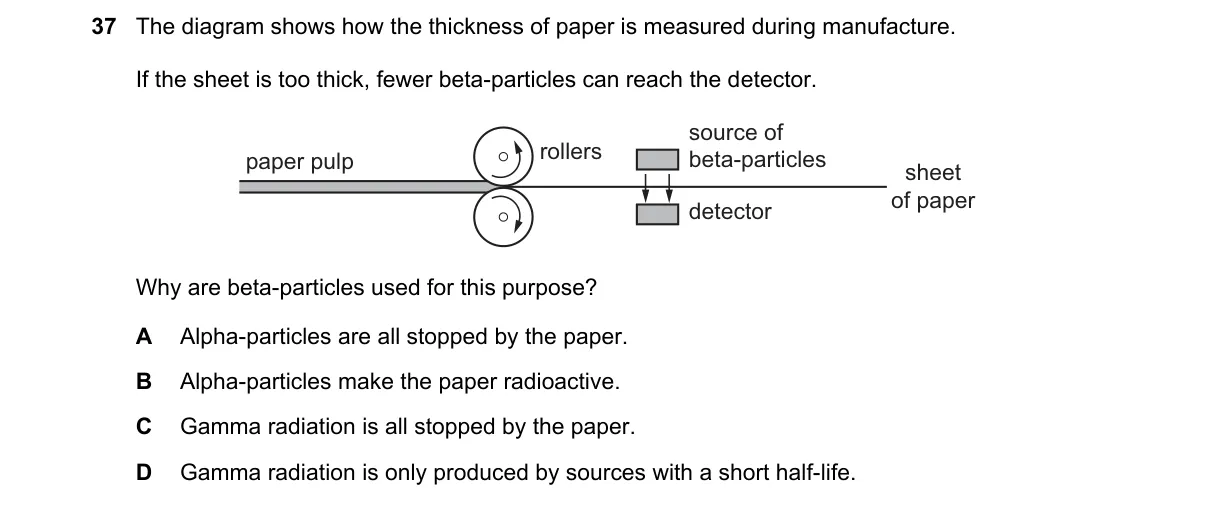
Answer choices
- AAlpha particles are stopped by the paper.
- BAlpha-particles make the paper radioactive.
- CGamma radiation is only produced by sources with a short half-life.
- DGamma radiation is only stopped by the paper.
Explanation
Beta particles penetrate paper variably for thickness detection
Steps:
- Beta particles from a source pass through the paper sheet to a detector, with absorption increasing as thickness grows.
- Thicker paper reduces beta particle count at the detector, allowing real-time thickness monitoring.
- Alpha particles lack sufficient penetration power for this application.
- Gamma rays penetrate too readily, providing minimal absorption variation.
Why A is correct:
- Alpha particles, being helium nuclei, have low penetration due to high ionization and are stopped by thin materials like paper, per radiation interaction principles.
Why the others are wrong:
- B: Alpha particles do not induce radioactivity in paper; they cause ionization without nuclear activation.
- C: Gamma radiation is emitted by many isotopes, regardless of half-life, including long-lived sources like cobalt-60.
- D: Gamma rays, being electromagnetic, penetrate paper easily and require dense materials like lead for stopping.
Final answer: A
Topic: The three types of emission
Practice more O Levels/IGCSE Physics (5054) questions on mMCQ.me