O Levels/IGCSE Physics (5054)•5054/11/M/J/23
O Levels/IGCSE Physics (5054) — 5054/11/M/J/23, Question 31
Three students each suggest a consequence of wiring lamps in parallel rather than in series. Student 1: If one lamp breaks, the other lamps stay lit. Student 2: The lamps can be switched on and off separately. Student 3: The p.d. across each lamp is equal to the p.d. across the supply. Which students are correct?
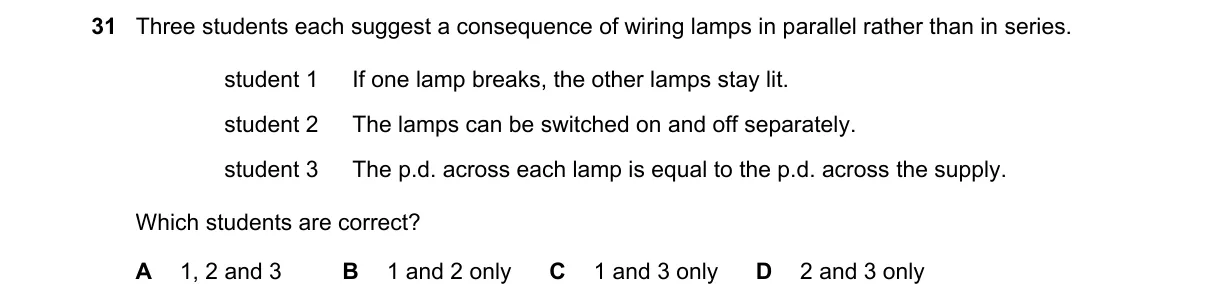
Answer choices
- A1, 2 and 3
- B1 and 2
- C1 and 3
- D2 and 3
Explanation
Parallel Circuit Advantages Over Series
Steps:
- In parallel wiring, each lamp connects directly to the supply, so breaking one opens only its path, leaving others lit (Student 1 correct).
- Parallel allows independent branches, enabling separate switches for each lamp (Student 2 correct).
- Voltage divides in series but remains equal across parallel branches to the supply voltage (Student 3 correct).
- All statements match parallel circuit properties, confirming option A.
Why A is correct:
- Parallel circuits maintain full supply voltage (V) across each component per Kirchhoff's voltage law, ensuring independent operation.
Why the others are wrong:
- B omits Student 3's valid voltage equality.
- C omits Student 2's independent switching.
- D omits Student 1's fault isolation.
Final answer: A
Topic: Series and parallel circuits
Practice more O Levels/IGCSE Physics (5054) questions on mMCQ.me