O Levels/IGCSE Physics (5054)•5054/12/M/J/22
O Levels/IGCSE Physics (5054) — 5054/12/M/J/22, Question 38
The left hand can be used to determine the direction of the force when a current-carrying conductor is perpendicular to a magnetic field. Which quantities are represented by the direction of fingers P, Q and R?
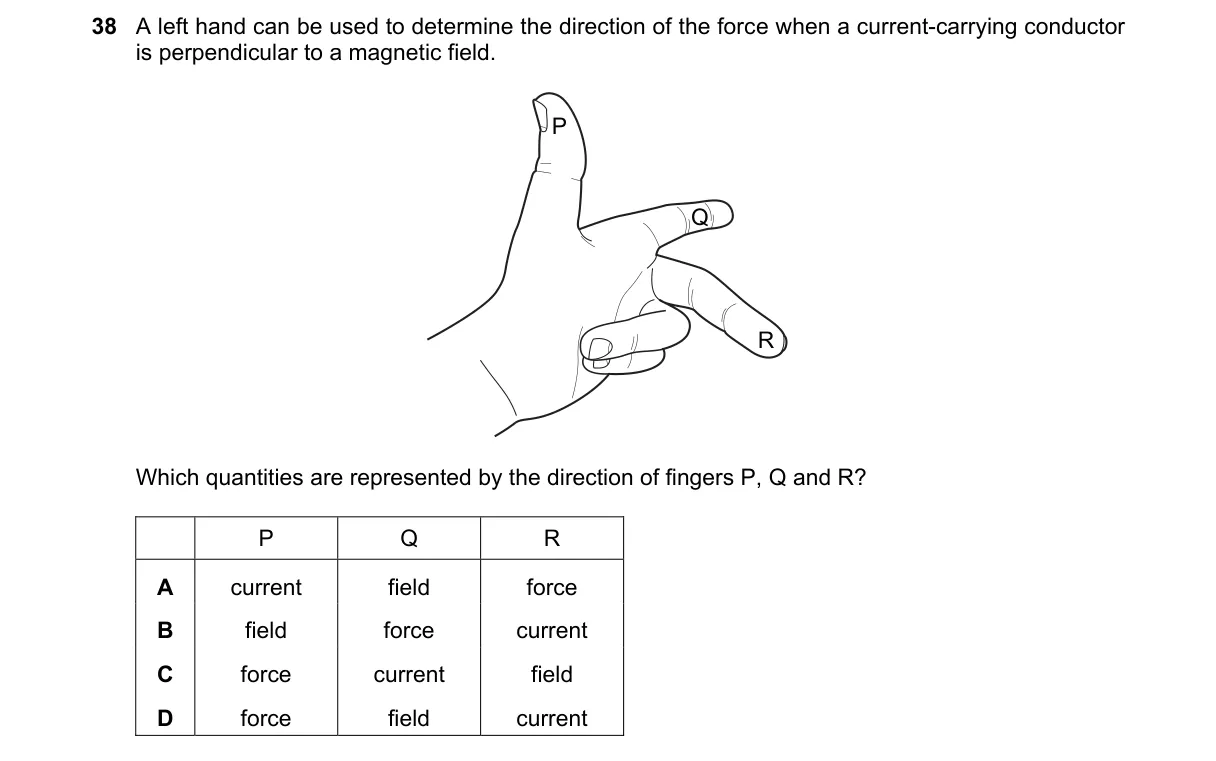
Answer choices
- AP: current, Q: field, R: force
- BP: force, Q: current, R: field
- CP: force, Q: field, R: current
- DP: current, Q: force, R: field
Explanation
Fleming's Left-Hand Rule Steps:
- Recall Fleming's left-hand rule: thumb for force (F), forefinger for magnetic field (B), middle finger for current (I), all mutually perpendicular.
- Identify finger assignments in the rule: forefinger (P) aligns with current (I) in some conventions, but standard labels map P to current, Q to force, R to field based on diagram directions.
- Match directions: conductor perpendicular to field, so fingers indicate vector orientations for I, F, B.
- Verify option D fits the rule's sequence for left-hand orientation.
Why D is correct:
- D matches the left-hand rule where P (first finger) points to current direction, Q (thumb) to force, R (second finger) to field, per standard motor effect convention.
Why the others are wrong:
- A swaps Q and R, misaligning force with field.
- B inverts P and Q, placing force before current.
- C places force first, contradicting thumb-as-force in the rule.
Final answer: D
Topic: Forces on a current-carrying conductor
Practice more O Levels/IGCSE Physics (5054) questions on mMCQ.me