O Levels/IGCSE Physics (5054)•5054/12/M/J/22
O Levels/IGCSE Physics (5054) — 5054/12/M/J/22, Question 27
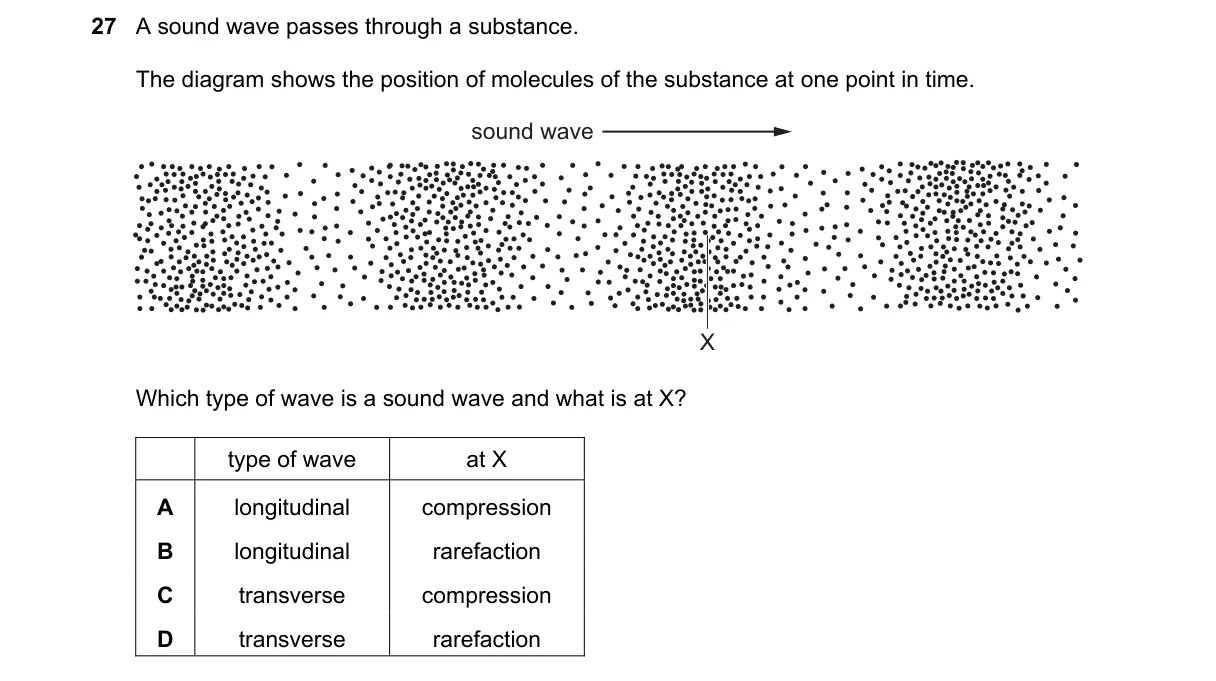
A sound wave passes through a substance. The diagram shows the position of molecules of the substance at one point in time. Which type of wave is a sound wave and what is at X
Answer choices
- Alongitudinal rarefaction
- Blongitudinal compression
- Ctransverse compression
- Dtransverse rarefaction
Explanation
Sound waves are longitudinal with alternating compressions and rarefactions
Steps:
- Sound waves involve particle vibrations parallel to the wave direction, classifying them as longitudinal.
- Longitudinal waves feature compressions (high particle density) and rarefactions (low particle density).
- The diagram shows molecule positions; X marks a region of spaced-out molecules, indicating low density.
- Thus, X represents a rarefaction in a longitudinal sound wave.
Why A is correct:
- Sound waves are longitudinal by definition, as they propagate via parallel molecular oscillations; rarefactions occur where molecules are spread apart, matching the low-density region at X.
Why the others are wrong:
- B: Compression involves high molecular density, opposite to the spaced-out molecules at X.
- C: Transverse waves have perpendicular particle motion, but sound requires parallel motion through substances.
- D: Transverse waves do not produce rarefactions in sound propagation, which is inherently longitudinal.
Final answer: A
Topic: Sound
Practice more O Levels/IGCSE Physics (5054) questions on mMCQ.me