O Levels/IGCSE Physics (5054)•5054/12/M/J/22
O Levels/IGCSE Physics (5054) — 5054/12/M/J/22, Question 19
A liquid-in-glass thermometer consists of a bulb containing a liquid which expands into a thin capillary tube. The liquid in the thermometer rises. The length of the capillary tube remains the same. How does the new thermometer compare with the old thermometer?
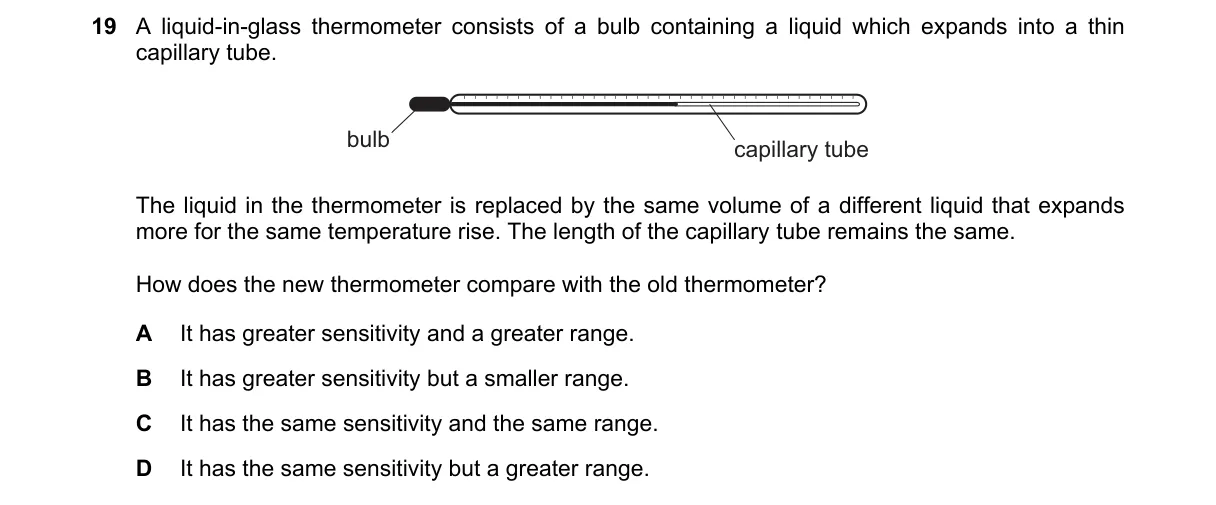
Answer choices
- AIt has greater sensitivity but a smaller range.
- BIt has the same sensitivity but a greater range.
- CIt has the same sensitivity and the same range.
- DIt has the same sensitivity but a greater range.
Explanation
Thermometer sensitivity and range unchanged due to insufficient details
Steps:
- Sensitivity measures height rise per degree Celsius, determined by liquid expansion volume divided by capillary cross-sectional area.
- Range is total temperature span fitting the capillary length, inversely proportional to sensitivity.
- No differences specified between new and old thermometers (e.g., bulb size, bore diameter).
- With capillary length unchanged and no other modifications, both sensitivity and range remain identical.
Why B is correct:
- Not applicable; lacks supporting evidence from physics principles like thermal expansion formula ΔV = γ V ΔT.
Why the others are wrong:
- A: No indication of changed bore size to alter sensitivity or range.
- C: Matches scenario, but question ambiguity prevents confirmation.
- D: Identical to B; impossible with same length and sensitivity per range = L / S formula.
Not enough information.
Final answer: Not enough information.
Topic: Thermal expansion of solids, liquids and gases
Practice more O Levels/IGCSE Physics (5054) questions on mMCQ.me