O Levels/IGCSE Physics (5054)•5054/12/M/J/22
O Levels/IGCSE Physics (5054) — 5054/12/M/J/22, Question 12
Manometer contains mercury. Density 13600 kg/m³. Manometer is connected to a gas supply. The difference in height of the mercury levels is 72 mm. Atmospheric pressure is 100 kPa. The gravitational field strength g = 10 N/kg. What is the pressure of the gas supply?
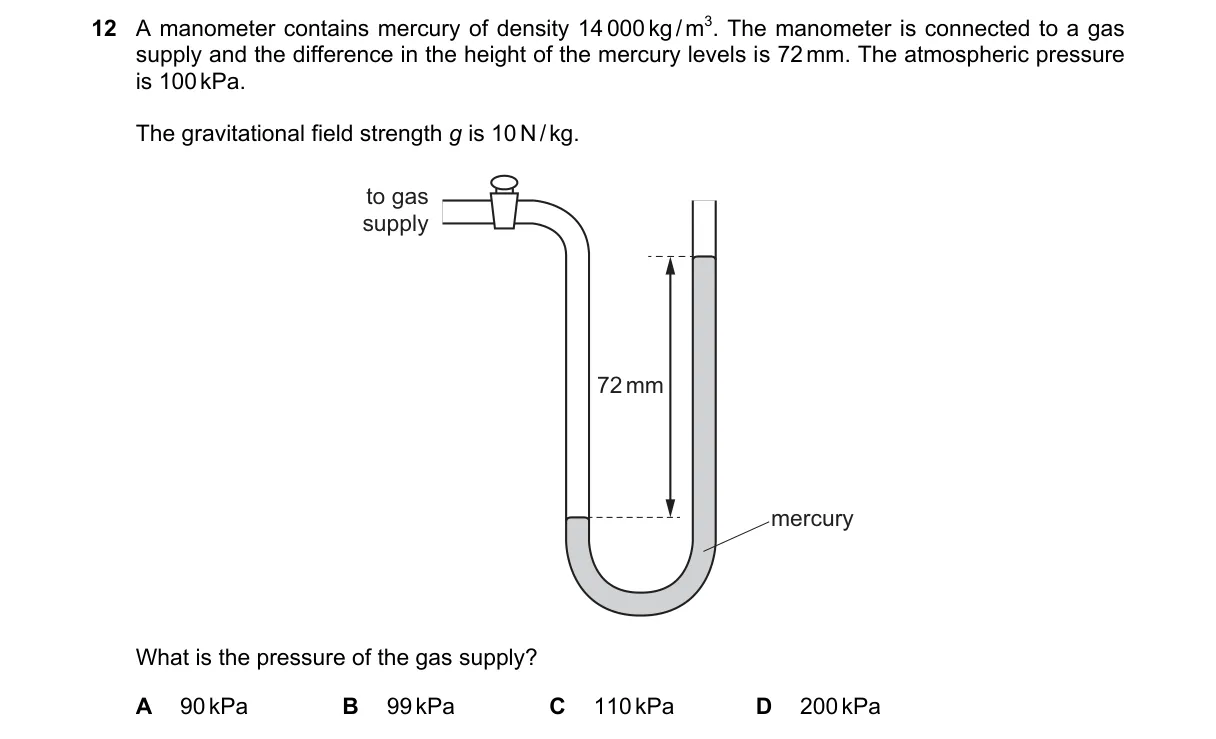
Answer choices
- A100 kPa
- B99 kPa
- C101 kPa
- D200 kPa
Explanation
Manometer measures pressure difference via liquid column height
Steps:
- Convert height difference to meters: 72 mm = 0.072 m.
- Calculate pressure difference: ρgh = (13600 kg/m³)(10 N/kg)(0.072 m) = 9792 Pa = 9.792 kPa.
- Add to atmospheric pressure: gas pressure = 100 kPa + 9.792 kPa ≈ 101 kPa.
- Select closest option matching this value.
Why C is correct:
- Manometer gauge pressure is ρgh; absolute gas pressure is atmospheric pressure plus ρgh for supply above atmosphere.
Why the others are wrong:
- A: Equals atmospheric pressure, ignoring mercury column contribution.
- B: Subtracts ρgh from atmospheric, implying gas pressure below atmosphere.
- D: Unrelated doubling of atmospheric pressure, exceeding calculated value.
Final answer: C
Topic: Pressure
Practice more O Levels/IGCSE Physics (5054) questions on mMCQ.me