O Levels/IGCSE Physics (5054)•5054/11/M/J/22
O Levels/IGCSE Physics (5054) — 5054/11/M/J/22, Question 40
In the Geiger-Marsden experiment, alpha-particles are fired at a thin gold sheet. Most alpha-particles pass straight through the thin gold sheet. A few are deflected. What can be deduced from this experiment?
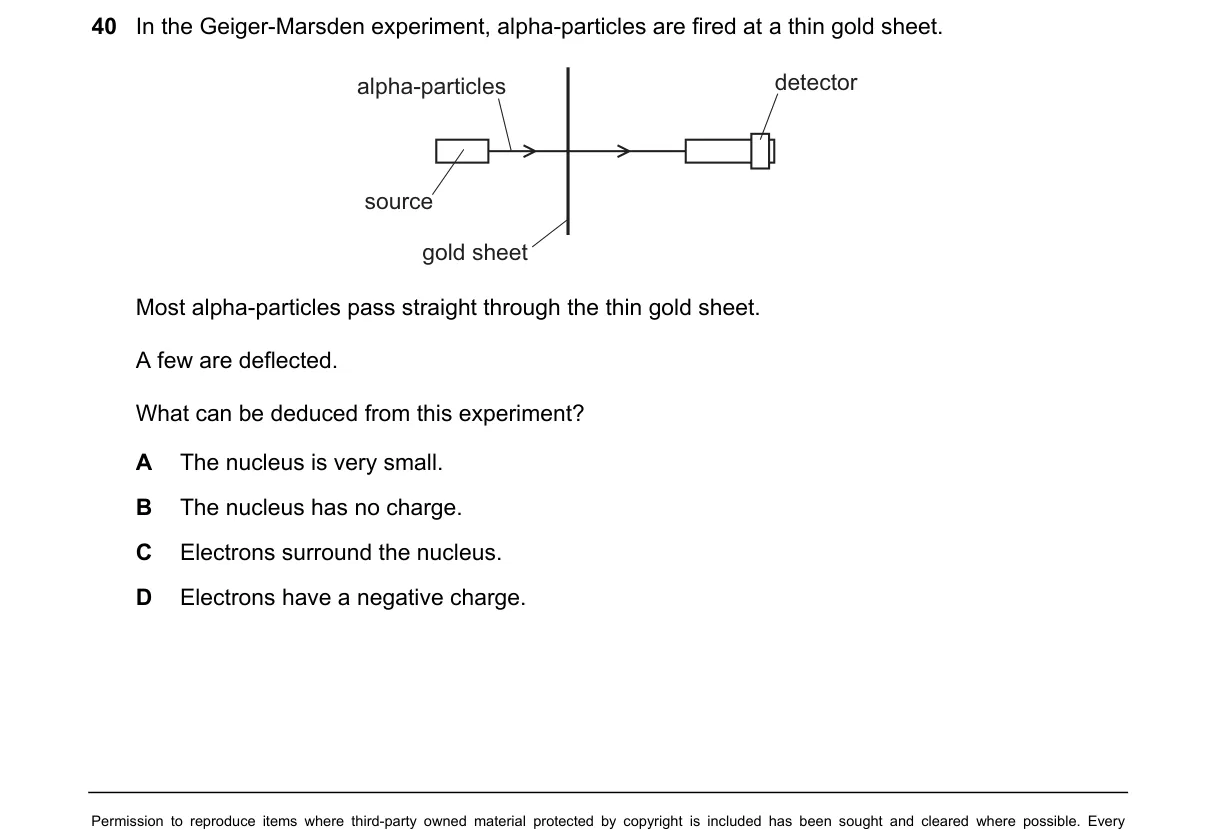
Answer choices
- AThe nucleus is very small.
- BThe nucleus has no charge.
- CElectrons surround the nucleus.
- DElectrons have a negative charge.
Explanation
Gold Foil Experiment Shows Atom's Mostly Empty Space
Steps:
- Most alpha particles pass undeflected, indicating atoms consist mostly of empty space.
- Rare deflections occur when alphas approach a central region closely.
- Large-angle scattering implies a tiny, massive, positively charged core repels alphas via Coulomb force.
- Thus, the nucleus must be very small to account for few interactions.
Why A is correct:
- The low deflection rate means the nucleus cross-section is ~10^-4 of the atom's, per Rutherford scattering formula, confirming its minuscule size.
Why the others are wrong:
- B: Deflections prove the nucleus is positively charged, repelling positive alphas.
- C: Passage through foil suggests empty space but doesn't specify electron arrangement.
- D: Electron charge was known from Thomson's work; experiment focuses on nuclear properties.
Final answer: A
Topic: The nucleus
Practice more O Levels/IGCSE Physics (5054) questions on mMCQ.me