O Levels/IGCSE Physics (5054)•5054/11/M/J/22
O Levels/IGCSE Physics (5054) — 5054/11/M/J/22, Question 16
A liquid-in-glass thermometer consists of a bulb containing a liquid which expands into a thin capillary tube. The liquid in the thermometer is replaced by the same volume of a different liquid that expands more for the same temperature rise. The length of the capillary tube remains the same. How does the new thermometer compare with the old thermometer?
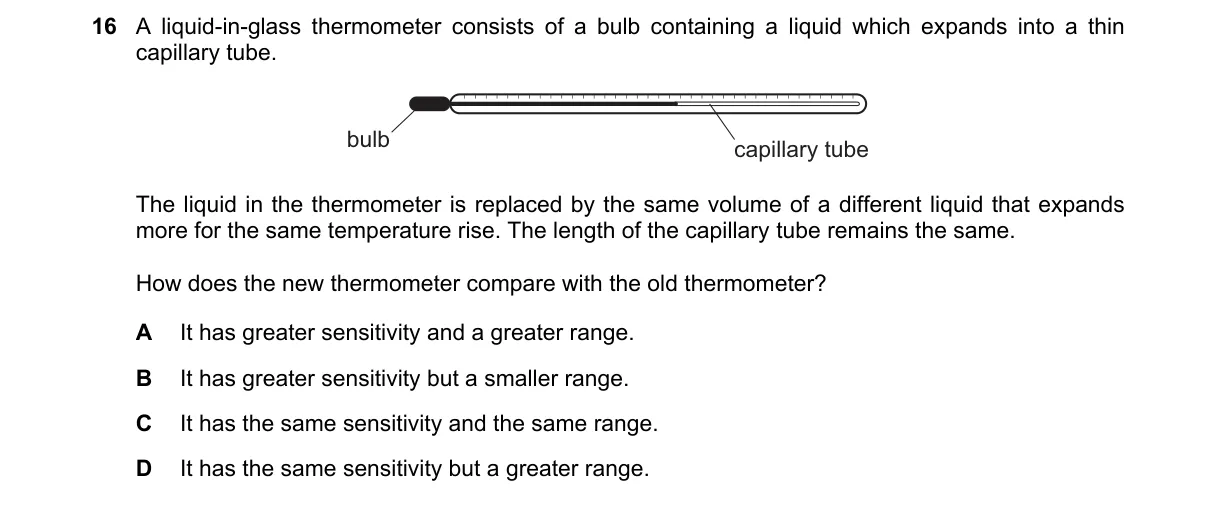
Answer choices
- AIt has greater sensitivity but a smaller range.
- BIt has greater sensitivity and a greater range.
- CIt has the same sensitivity but a greater range.
- DIt has the same sensitivity and the same range.
Explanation
Effect of thermal expansion on thermometer performance Steps:
- Sensitivity measures length change in the liquid column per unit temperature rise; larger expansion coefficient γ causes greater length change per °C.
- With same bulb volume V and capillary cross-section a, sensitivity dh/dT = (V γ)/a increases as γ increases.
- Range is maximum ΔT before liquid fills tube of length L; total expansion volume is aL.
- Max ΔT = (aL)/(V γ), so larger γ reduces max ΔT, giving smaller range.
Why A is correct:
- Larger γ boosts sensitivity via dh/dT ∝ γ but shrinks range via ΔT_max ∝ 1/γ, per volume expansion principles.
Why the others are wrong:
- B: Range decreases, not increases.
- C: Sensitivity increases, not stays same.
- D: Both sensitivity and range change.
Final answer: A
Topic: Thermal expansion of solids, liquids and gases
Practice more O Levels/IGCSE Physics (5054) questions on mMCQ.me