O Levels/IGCSE Physics (5054)•5054/11/M/J/21
O Levels/IGCSE Physics (5054) — 5054/11/M/J/21, Question 18
What is the heat capacity of a body?
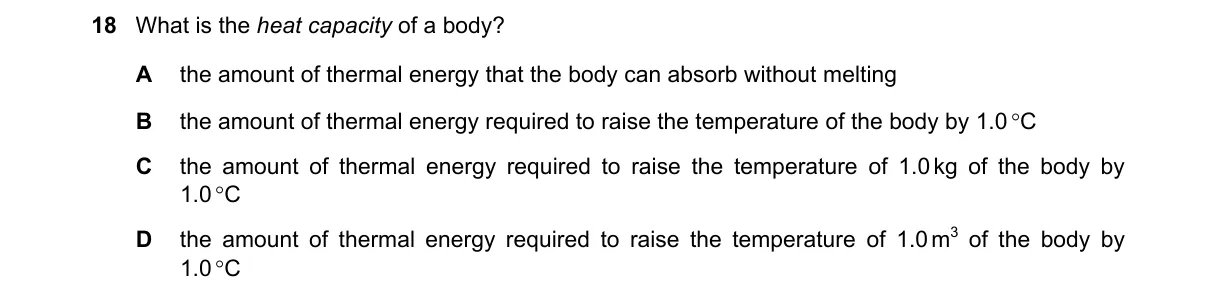
Answer choices
- Athe amount of heat the body can absorb without melting
- Bthe amount of thermal energy required to raise the temperature of the body by 1°C
- Cthe amount of thermal energy required to raise the temperature of 1kg of the body by 1°C
- Dthe amount of thermal energy required to raise the temperature of 1 mol of the body by 1°C
Explanation
Heat Capacity as Total Thermal Response
Steps:
- Define heat capacity as the heat Q needed to change the temperature of an object by ΔT, given by C = Q / ΔT.
- Identify that for a body, this applies to the entire object, not normalized by mass or moles.
- Compare choices: A involves phase change, C specifies per kg (specific heat), D per mole (molar heat).
- Select B as it matches the total heat for 1°C rise without normalization.
Why B is correct:
- Heat capacity C is defined as the thermal energy required to raise the temperature of the entire body by 1°C, per the formula C = Q / ΔT.
Why the others are wrong:
- A: Refers to latent heat for phase change, not temperature rise.
- C: Describes specific heat capacity, which is per kilogram.
- D: Describes molar heat capacity, which is per mole.
Final answer: B
Topic: Specific heat capacity
Practice more O Levels/IGCSE Physics (5054) questions on mMCQ.me