O Levels/IGCSE Physics (5054)•5054/11/M/J/21
O Levels/IGCSE Physics (5054) — 5054/11/M/J/21, Question 13
The work done by a force F on a body is calculated by multiplying F by a quantity q. What is q?
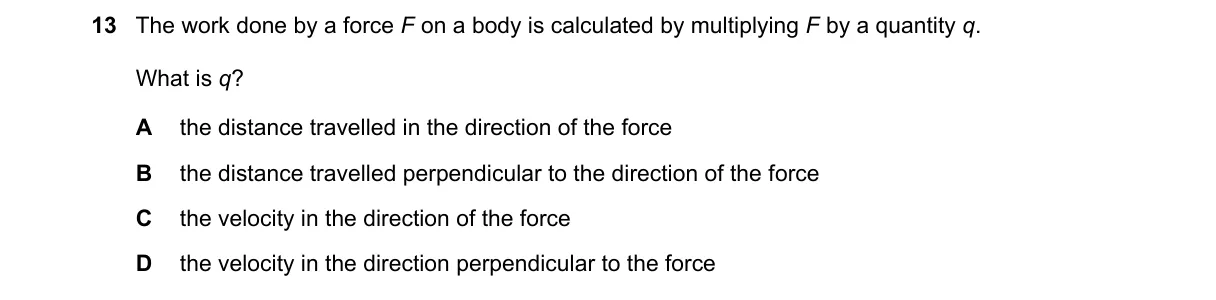
Answer choices
- Athe distance travelled in the direction of the force
- Bthe distance travelled perpendicular to the direction of the force
- Cthe velocity travelled perpendicular to the direction of the force
- Dthe velocity in the direction perpendicular to the force
Explanation
Work-energy principle: work equals force times parallel displacement
Steps:
- Recall the definition of work done by a force: integral of F dot ds, or F times displacement component parallel to F.
- For constant force, simplify to W = F * d * cosθ, where d is total displacement and θ is angle between F and displacement.
- When θ = 0 (force along displacement), cosθ = 1, so W = F * d, with d as distance in force's direction.
- Thus, q is the distance traveled in the direction of the force.
Why A is correct:
- Matches the physics definition: work W = F · s, where s is displacement vector; scalar product yields F times parallel component of distance.
Why the others are wrong:
- B: Perpendicular distance gives cos90° = 0, so no work done.
- C: Work formula uses displacement, not velocity; velocity relates to kinetic energy, not direct work calculation.
- D: Perpendicular velocity irrelevant; work depends on displacement direction, not speed components.
Final answer: A
Topic: Work
Practice more O Levels/IGCSE Physics (5054) questions on mMCQ.me