O Levels/IGCSE Physics (5054)•5054/12/M/J/20
O Levels/IGCSE Physics (5054) — 5054/12/M/J/20, Question 15
A small vessel of volume 3.0 cm³ contains air at a pressure of 100 kPa. The small vessel is connected to a syringe. The piston is fully inserted into the syringe. The piston is moved slowly to the right so that the air in the syringe has a volume of 12 cm³. The temperature of the air does not change. What is the pressure of the air in the syringe?
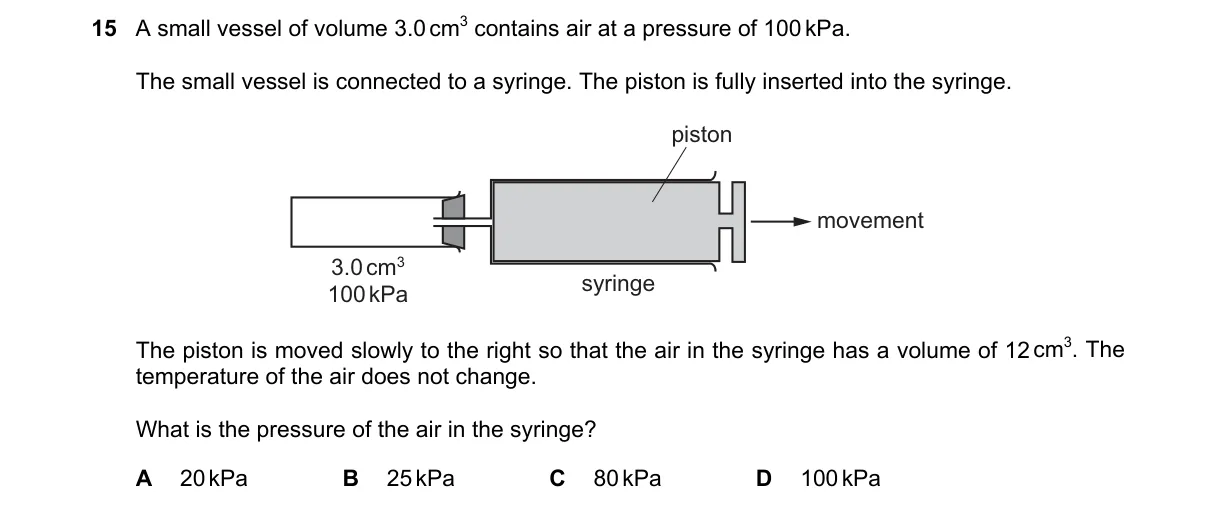
Answer choices
- A20 kPa
- B25 kPa
- C80 kPa
- D100 kPa
Explanation
Boyle's Law: Isothermal Gas Expansion
Steps:
- Initial conditions: Volume V1 = 3.0 cm³, pressure P1 = 100 kPa.
- Final conditions: Syringe volume = 12 cm³, total volume V2 = 3.0 cm³ + 12 cm³ = 15 cm³ (air expands from vessel into syringe).
- Apply Boyle's law: P1 V1 = P2 V2 (constant temperature).
- Solve for P2: P2 = (P1 V1) / V2 = (100 kPa × 3.0 cm³) / 15 cm³ = 20 kPa.
Why A is correct:
- Boyle's law (P V = constant at fixed T) gives P2 = 20 kPa as the air expands to total 15 cm³.
Why the others are wrong:
- B: Ignores vessel volume, incorrectly using P2 = 100 kPa × (3/12) = 25 kPa.
- C: Misapplies ratio, e.g., 100 kPa × (12/15) = 80 kPa.
- D: Assumes pressure unchanged, violating Boyle's law.
Final answer: A
Topic: Particle model
Practice more O Levels/IGCSE Physics (5054) questions on mMCQ.me