O Levels/IGCSE Physics (5054)•5054/12/M/J/20
O Levels/IGCSE Physics (5054) — 5054/12/M/J/20, Question 10
The diagram shows the equipment used to determine the density of a liquid. Which equation is used to calculate the density of the liquid?
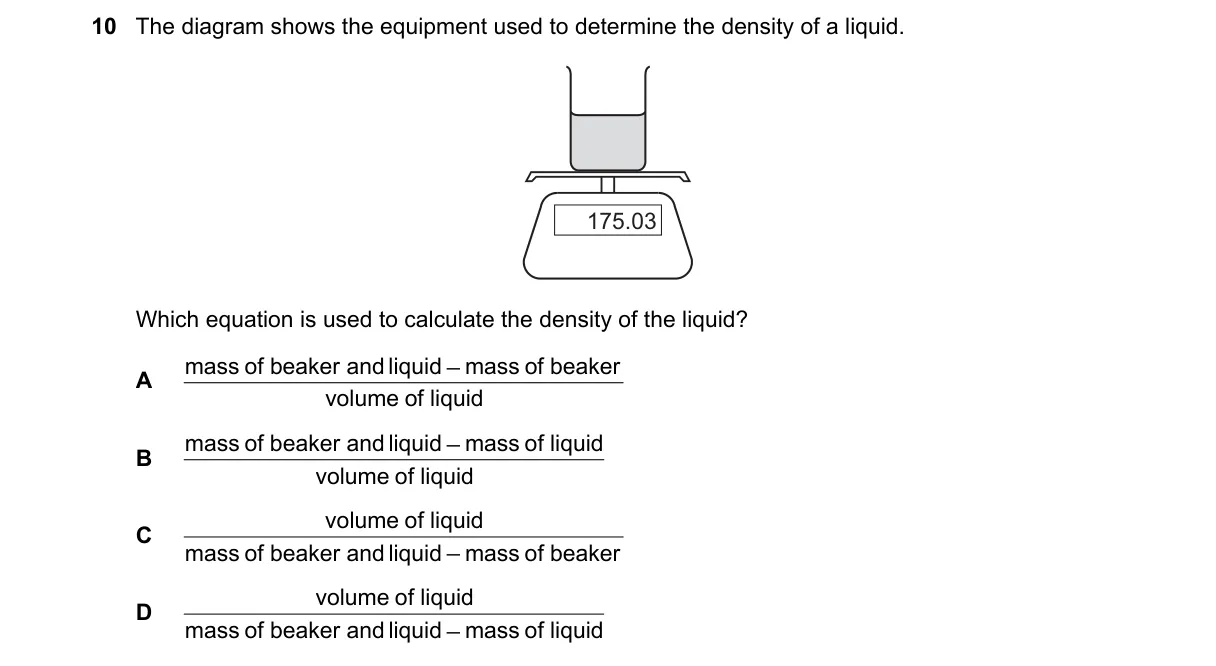
Answer choices
- A(mass of beaker and liquid - mass of beaker) / volume of liquid
- B(mass of beaker and liquid - mass of liquid) / volume of liquid
- Cmass of beaker + volume of liquid - mass of beaker
- Dmass of beaker + liquid - mass of liquid
Explanation
Calculating liquid density from mass difference and volume
Steps:
- Measure the mass of the empty beaker.
- Pour liquid into the beaker and measure the combined mass.
- Subtract the empty beaker mass from the combined mass to find the liquid's mass.
- Measure the liquid's volume using a graduated cylinder, then divide mass by volume for density.
Why A is correct:
- Density is defined as mass divided by volume; A computes the liquid's mass by subtraction and divides by its volume, matching the formula ρ = m/V.
Why the others are wrong:
- B subtracts the liquid's mass (unknown) from the total, yielding the beaker's mass instead of the liquid's, which is circular and incorrect.
- C adds unrelated quantities without division, producing a nonsensical result unrelated to density.
- D only manipulates masses without volume or division, failing to compute density.
Final answer: A
Topic: Density
Practice more O Levels/IGCSE Physics (5054) questions on mMCQ.me