O Levels/IGCSE Physics (5054)•5054/11/M/J/20
O Levels/IGCSE Physics (5054) — 5054/11/M/J/20, Question 40
A kettle is connected to 240V supply using a plug containing a 13A fuse. When it is switched on, the fuse blows. This happens after a new fuse is fitted. Someone replaces the fuse with a nail, and the kettle works. What else might happen as a result of replacing the fuse with a nail?
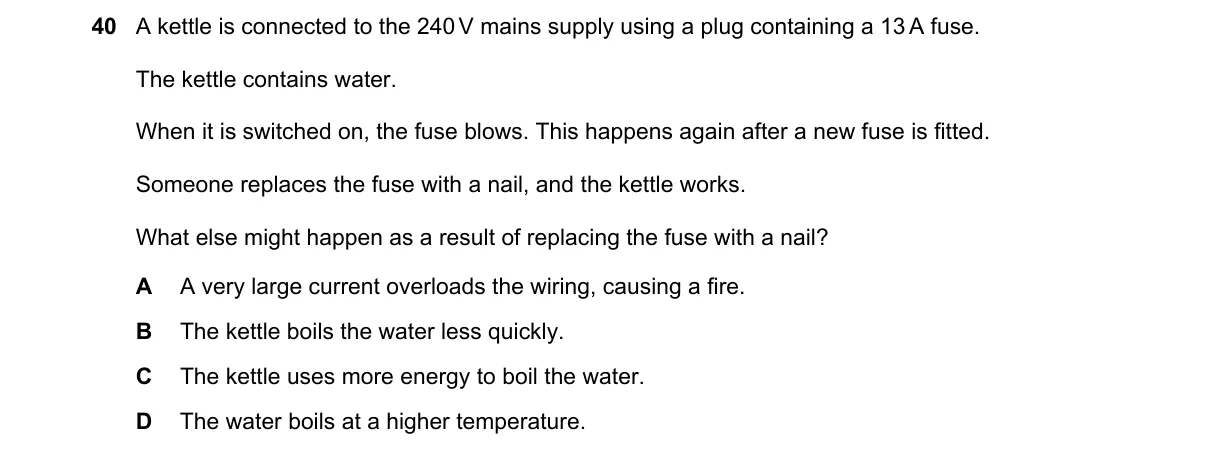
Answer choices
- AA very large current overloads the wiring, causing a fire.
- BThe kettle uses more water to boil.
- CThe water boils at a higher temperature.
- DThe fuse blows less quickly.
Explanation
Fuses prevent circuit overloads; nails do not.
Steps:
- The fuse blows due to excessive current from the kettle, indicating a fault like a short circuit.
- Replacing with a nail bypasses the fuse's protective function, as nails conduct electricity without melting.
- Without protection, high current can flow unchecked through the wiring.
- This overloads the house wiring, generating heat that may ignite a fire.
Why A is correct:
- Fuses are designed to melt at a specific current (per Ohm's law, I = V/R; high I causes heat), protecting wiring; a nail lacks this limit, allowing dangerous overloads.
Why the others are wrong:
- B: Fuse type doesn't affect water volume needed to boil.
- C: Boiling point of water is fixed at 100°C at standard pressure, independent of electrical issues.
- D: No real fuse exists with the nail, so blowing doesn't apply.
Final answer: A
Topic: Electrical safety
Practice more O Levels/IGCSE Physics (5054) questions on mMCQ.me