O Levels/IGCSE Physics (5054)•5054/11/M/J/20
O Levels/IGCSE Physics (5054) — 5054/11/M/J/20, Question 12
A rocket of mass M when empty carries a mass M of fuel. The rocket and fuel are at speed v. The rocket is fired and all of the fuel is expelled. The speed of the rocket increases to 2v. What happens to the kinetic energy of the rocket?
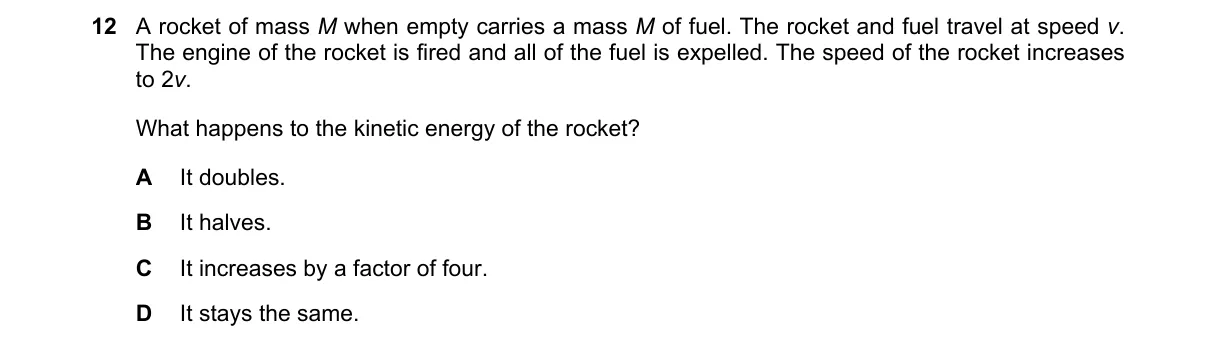
Answer choices
- AIt doubles.
- BIt halves.
- CIt increases by a factor of four.
- DIt stays the same.
Explanation
Kinetic energy scales with the square of velocity for the empty rocket.
Steps:
- Initial mass of empty rocket: M; initial speed: v; initial KE = (1/2)Mv².
- Final mass of empty rocket: M; final speed: 2v; final KE = (1/2)M(2v)² = (1/2)M(4v²) = 2Mv².
- Ratio of final to initial KE: [2Mv²] / [(1/2)Mv²] = 4.
- Thus, KE increases by a factor of four.
Why C is correct:
- Kinetic energy formula KE = (1/2)mv² shows doubling velocity multiplies KE by 4 for constant mass.
Why the others are wrong:
- A: Doubling would occur if velocity increased linearly, but KE depends on v².
- B: Halving ignores the velocity increase and quadratic dependence.
- D: KE changes due to velocity doubling, per conservation of momentum in rocket propulsion.
Final answer: C
Topic: Energy
Practice more O Levels/IGCSE Physics (5054) questions on mMCQ.me