O Levels/IGCSE Physics (5054)•5054/12/M/J/19
O Levels/IGCSE Physics (5054) — 5054/12/M/J/19, Question 38
A teacher uses the circuit shown. The identical lamps X and Y are connected to a low voltage a.c. supply by high resistance transmission wires. Lamp X is then switched on. Lamp Y stays switched on. What happens to the voltage across lamp X and the power supplied to lamp Y?
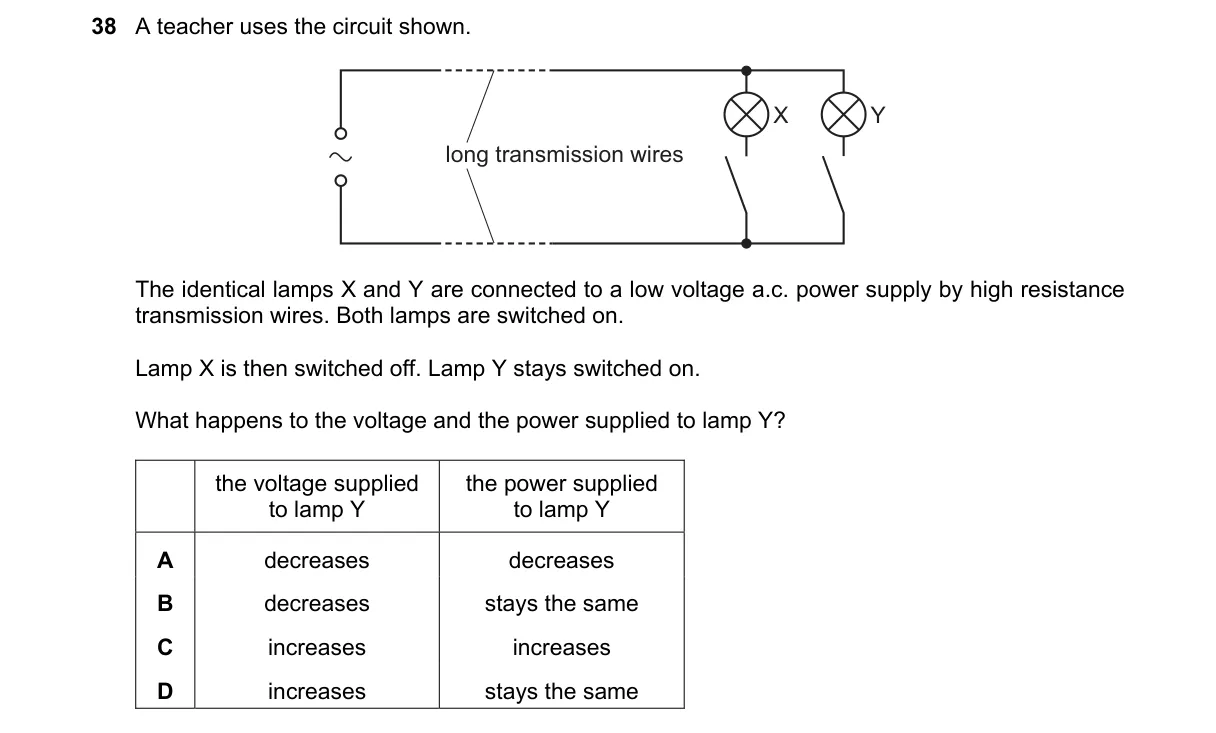
Answer choices
- Athe voltage supplied to lamp X decreases the power supplied to lamp Y decreases
- Bthe voltage supplied to lamp X decreases the power supplied to lamp Y stays the same
- Cthe voltage supplied to lamp X increases the power supplied to lamp Y stays the same
- Dthe voltage supplied to lamp X increases the power supplied to lamp Y increases
Explanation
Independent branches prevent interaction between lamps
Steps:
- Lamp Y is on initially, with its own current through its high-resistance wire; lamp X is off, so voltage across X is 0 V.
- Switching X on completes its branch circuit, producing voltage V_X = V_supply × R_lamp / (R_wire + R_lamp) > 0 V across X.
- Each lamp has a separate branch from the supply, so current in X's wire does not flow through or affect Y's branch.
- Power to Y remains P = (V_Y)^2 / R_lamp, unchanged since V_Y is unaffected.
Why C is correct:
- Separate branches ensure switching X on raises its voltage from 0 V (no circuit) to operating value, while Y's power stays constant per Ohm's law in isolated loops.
Why the others are wrong:
- A: Voltage across X increases, not decreases; power to Y unchanged due to independence.
- B: Voltage across X increases from 0 V, not decreases.
- D: Power to Y stays the same, not increases, as no shared current path.
Final answer: C
Topic: Series and parallel circuits
Practice more O Levels/IGCSE Physics (5054) questions on mMCQ.me