O Levels/IGCSE Physics (5054) — 5054/12/M/J/19, Question 34
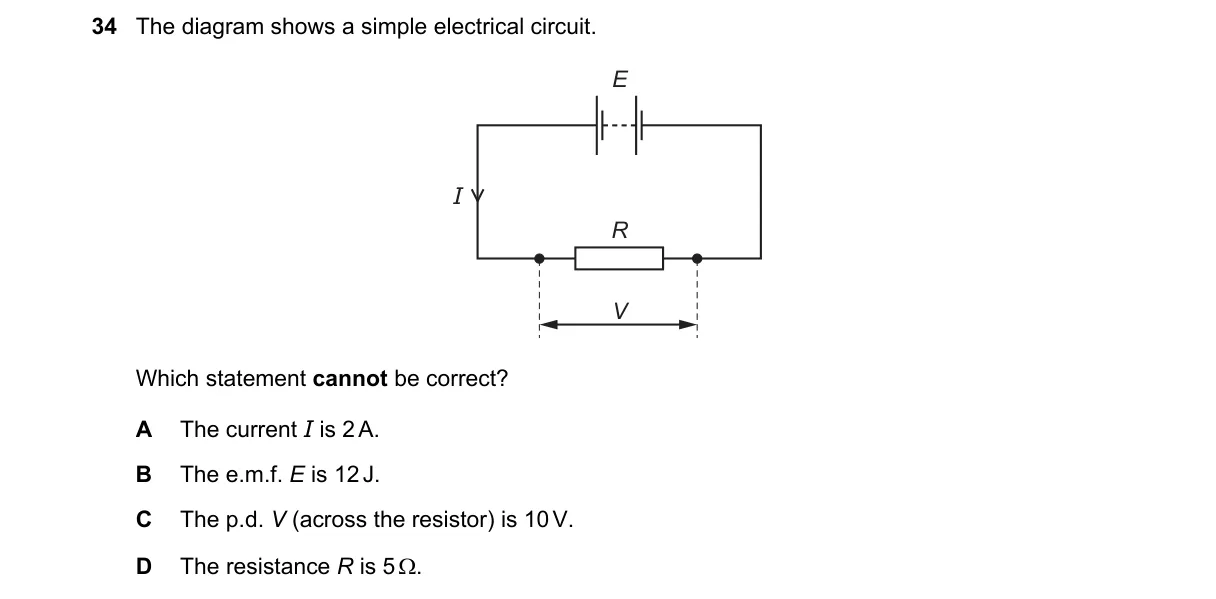
Answer choices
- AThe current is 2A
- BThe emf is 12V
- CThe p.d. across the resistor is 10V
- DThe resistance R is 5Ω
Explanation
Ohm's Law and Kirchhoff's Voltage Law in a Simple Series Circuit Steps: - Calculate potential difference across resistor using Ohm's law: V = I × R. - If I = 2 A and R = 5 Ω, then V = 2 × 5 = 10 V. - In a simple series circuit with ideal battery and resistor, emf equals pd across resistor by Kirchhoff's voltage law. - Thus, emf must be 10 V, not 12 V. Why B is correct: - Emf cannot be 12 V because it must equal the 10 V pd across the resistor, per Kirchhoff's voltage law (sum of voltages in loop is zero, so ε = V_R). Why the others are wrong: - A is possible: Current of 2 A is consistent with V = 10 V and R = 5 Ω via Ohm's law. - C is possible: Pd of 10 V matches I × R = 2 A × 5 Ω. - D is possible: Resistance of 5 Ω fits V = I × R = 10 V with I = 2 A. …
Practice more O Levels/IGCSE Physics (5054) questions on mMCQ.me