O Levels/IGCSE Physics (5054)•5054/12/M/J/19
O Levels/IGCSE Physics (5054) — 5054/12/M/J/19, Question 32
The diagram shows a car ignition switch and starter motor. The ignition switch is in a circuit with long wires. The starter motor is in a circuit with short, thick wires. What is the explanation for the choice of wires?
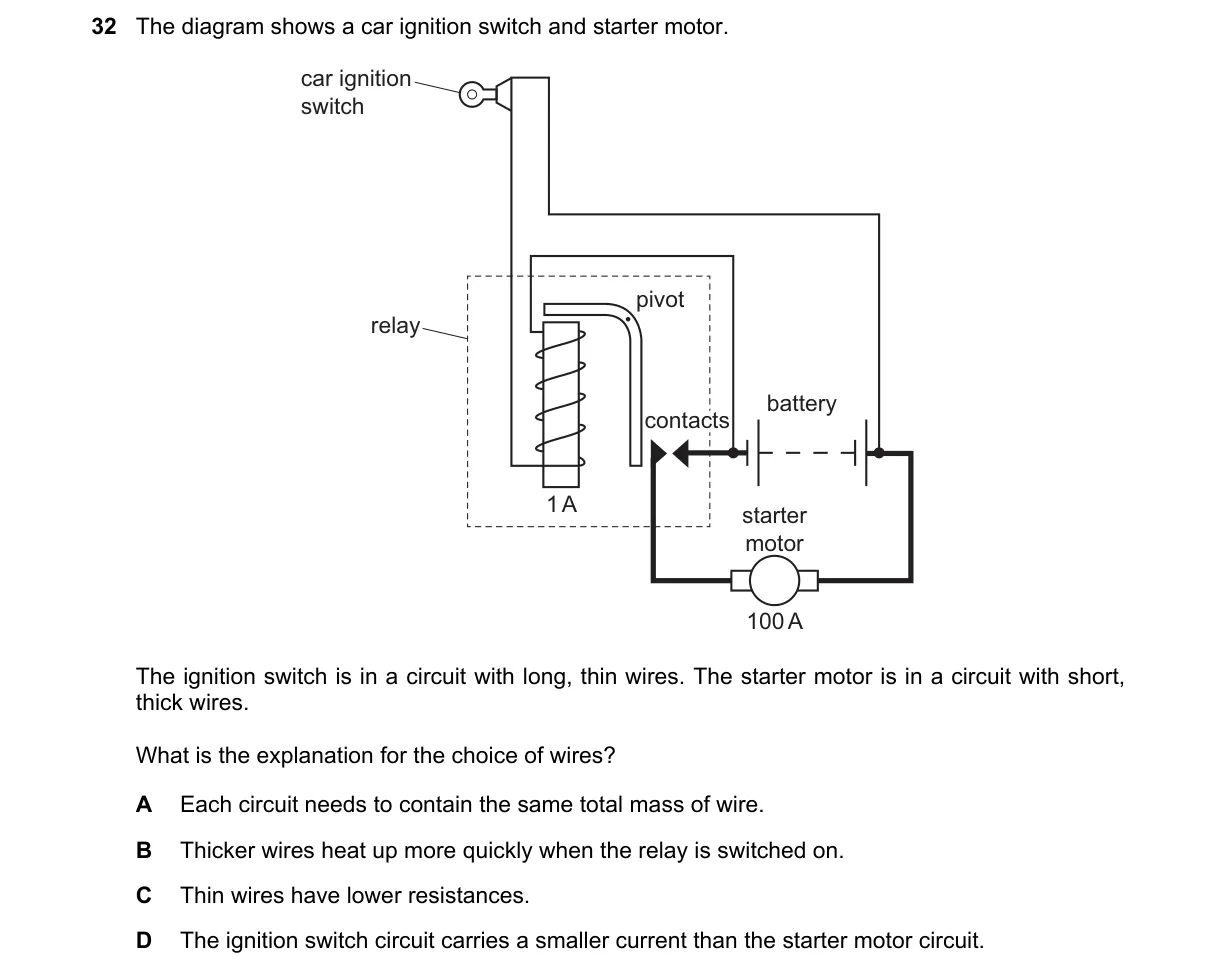
Answer choices
- AThicker wires heat up more quickly when the relay is switched on.
- BThin wires have lower resistance.
- CThe ignition switch circuit carries a smaller current than the starter motor circuit.
- DThe ignition switch carries a smaller current than the starter motor circuit.
Explanation
Wire gauge matches current load
Steps:
- Identify currents: Starter motor draws high current (hundreds of amps) to crank engine; ignition switch handles low current (few amps) for control signals.
- Recall wire properties: Resistance R = ρL/A; thicker wires (larger A) reduce R, minimizing voltage drop and heat for high currents.
- Compare circuits: Long, thin wires suit low-current ignition path; short, thick wires suit high-current starter path to avoid excessive power loss.
- Conclude: Wire choice prevents overheating and ensures efficient operation based on current differences.
Why D is correct:
- Ohm's law (V=IR) and power loss (P=I²R) require low-resistance thick wires for high-current starter circuits, while low-current ignition allows thin wires.
Why the others are wrong:
- A: Thicker wires have lower resistance, so they heat up less, not more.
- B: Thin wires have higher resistance due to smaller cross-section.
- C: While similar, it incorrectly focuses on entire circuits rather than components; starter circuit current is high at the motor, but ignition switch specifically carries low current.
Final answer: D
Topic: Uses of electricity
Practice more O Levels/IGCSE Physics (5054) questions on mMCQ.me