O Levels/IGCSE Physics (5054)•5054/11/M/J/19
O Levels/IGCSE Physics (5054) — 5054/11/M/J/19, Question 30
The ignition switch is in a circuit with long, thin wires. The starter motor is in a circuit with short, thick wires. What is the explanation for the choice of wires?
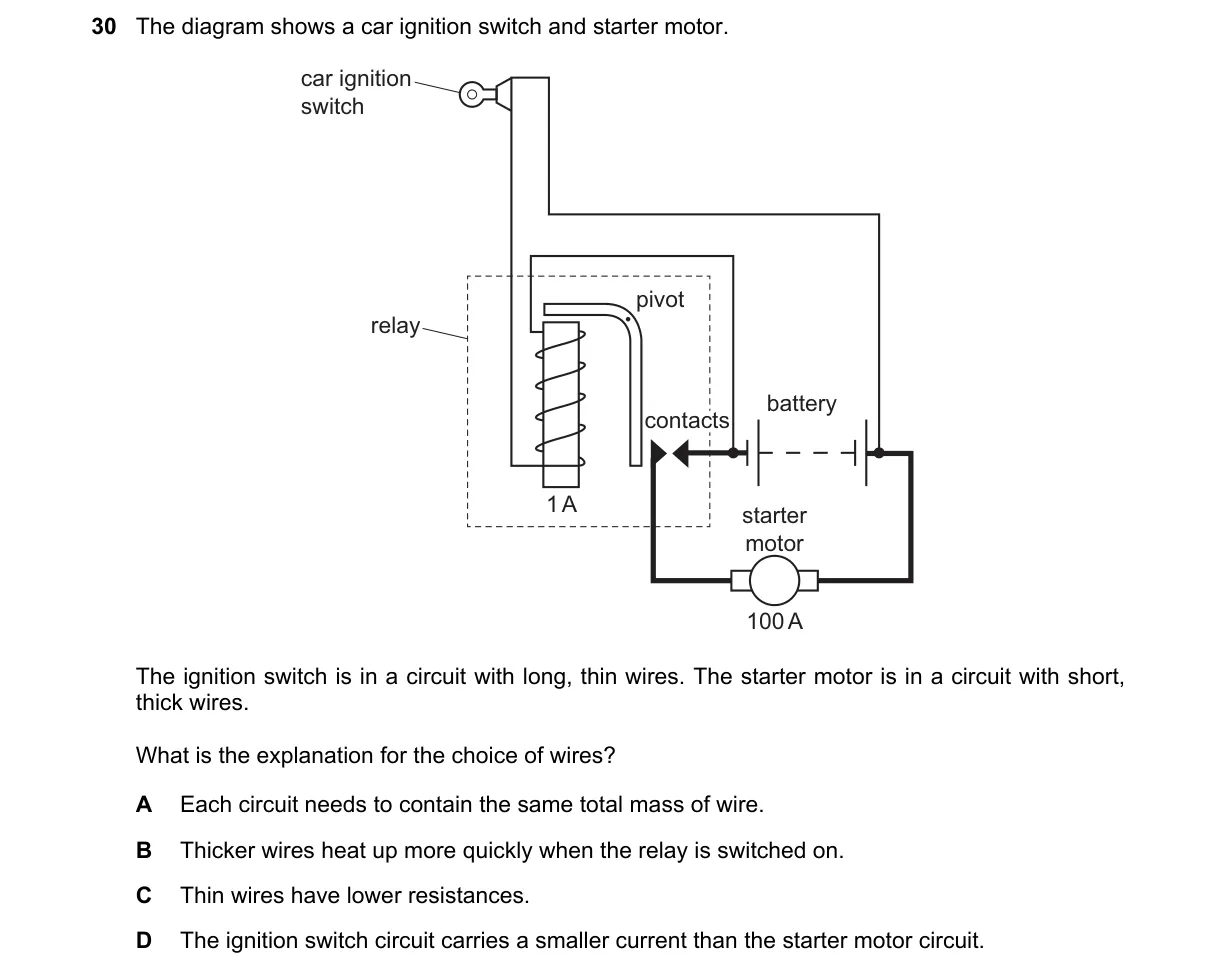
Answer choices
- AEach circuit needs to contain the same current.
- BThicker wires heat up more quickly when the relay is switched.
- CThin wires have lower resistance.
- DThe ignition switch circuit carries a smaller current than the starter motor circuit.
Explanation
Wire gauge matches current load for efficiency and safety
Steps:
- Identify circuit functions: Ignition switch controls low-power signals; starter motor draws high current to crank the engine.
- Recall wire properties: Resistance R = ρL/A, where thicker wires (larger A) reduce resistance for high-current paths.
- Compare needs: Starter requires low-resistance path to minimize voltage drop and heat; ignition needs minimal wire to avoid signal loss.
- Conclude: Wire thickness scales with current to prevent overheating and ensure performance.
Why D is correct:
- Starter motors draw hundreds of amps (high current) per Ohm's law (I = V/R), while ignition circuits carry milliamps, so thin wires suffice for low current without excessive resistance.
Why the others are wrong:
- A: Circuits carry different currents based on load, not the same.
- B: Thicker wires heat less due to lower resistance, not more.
- C: Thin wires have higher resistance, increasing voltage drop.
Final answer: D
Topic: Resistance
Practice more O Levels/IGCSE Physics (5054) questions on mMCQ.me