O Levels/IGCSE Physics (5054)•5054/11/M/J/19
O Levels/IGCSE Physics (5054) — 5054/11/M/J/19, Question 20
The diagram shows air trapped in a flask by a small volume of water in a thin tube. When the flask is held in a student's hands, the small volume of water first moves down from P to Q, and then up. Why does the small volume of water move like this?
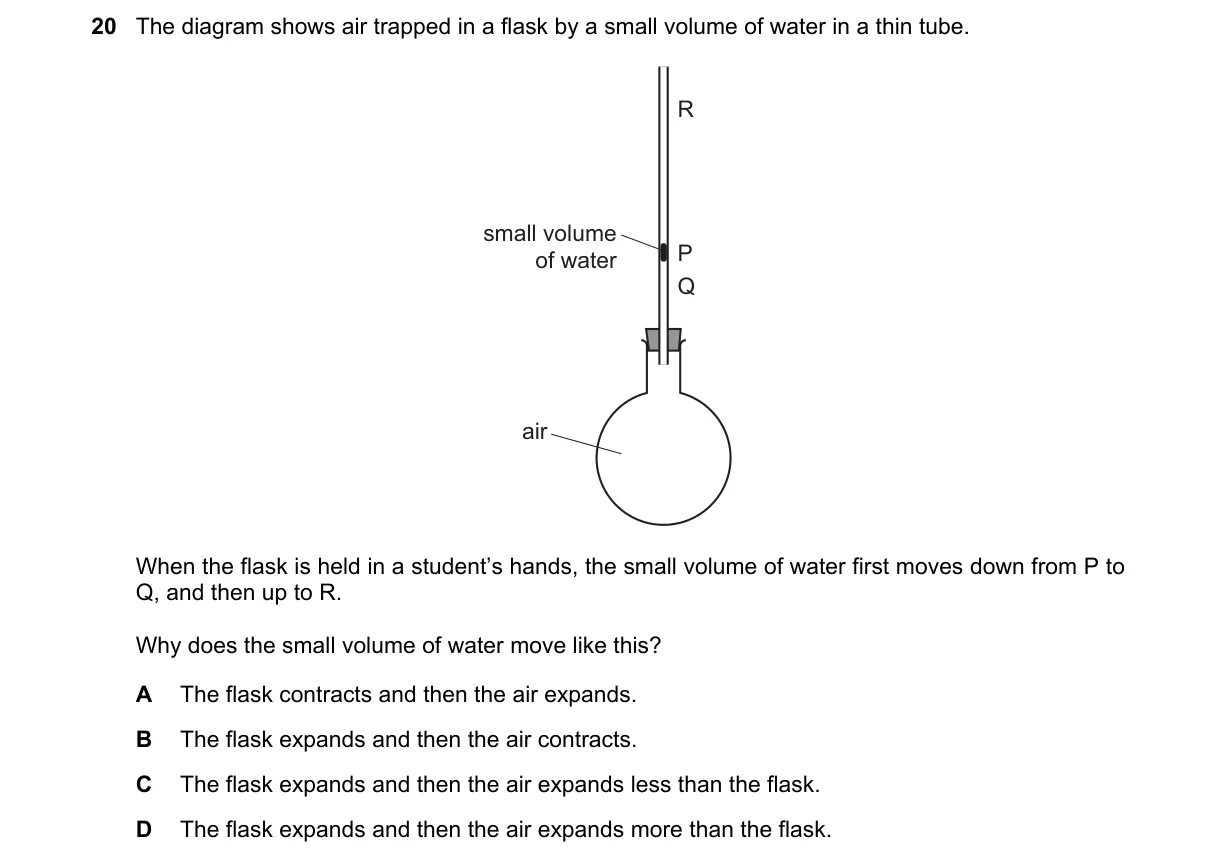
Answer choices
- AThe flask contracts and then the air expands.
- BThe flask expands and then the air contracts less than the flask.
- CThe flask expands and then the air expands more than the flask.
- DOption D
Explanation
Differential thermal expansion Steps:
- Hands warm the trapped air faster than the glass flask.
- Air expands more than the flask initially, raising internal pressure above atmospheric and pushing water down from P to Q.
- Glass then expands as it warms, increasing flask volume.
- Total volume now exceeds air expansion, dropping pressure below atmospheric and pulling water up. Why D is correct:
- D states the air expands more than the flask first (pressure up), then flask expands more than air (pressure down), per Charles's law (gas volume ∝ temperature) and linear expansion coefficients (air expands ~10x more than glass per °C). Why the others are wrong:
- A: Flask expands with heat, does not contract.
- B: Air expands continuously with warming, does not contract.
- C: Sequence reversed; air expands more initially, not flask first. Final answer: D
Topic: Thermal expansion of solids, liquids and gases
Practice more O Levels/IGCSE Physics (5054) questions on mMCQ.me