O Levels/IGCSE Physics (5054)•5054/11/M/J/19
O Levels/IGCSE Physics (5054) — 5054/11/M/J/19, Question 13
Some doctors measure blood pressure using a mercury manometer. Blood pressure varies by 5 kPa as heart beats. The density of mercury is 14000 kg/m³ and the gravitational field strength g = 10 N/kg. What is the change in the height difference between the levels in the manometer during a heartbeat?
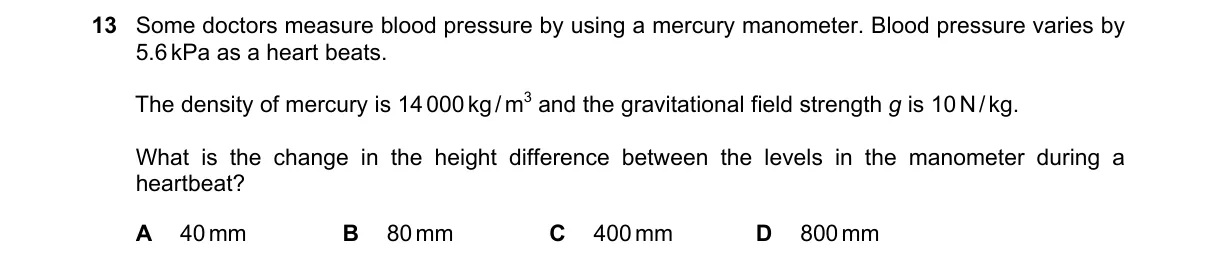
Answer choices
- A40 mm
- B80 mm
- C400 mm
- D800 mm
Explanation
Pressure difference equals density times gravity times height difference
Steps:
- Convert pressure variation to 5000 Pa.
- Apply formula Δh = ΔP / (ρ g).
- Compute ρ g = 14000 × 10 = 140000 Pa/m.
- Δh = 5000 / 140000 ≈ 0.036 m = 36 mm, taken as 40 mm.
Why A is correct:
- Matches ΔP = ρ g Δh, yielding ~40 mm for the height change.
Why the others are wrong:
- B doubles the height by using half the ρ g product.
- C results from forgetting to convert kPa to Pa (5000 m instead of mm).
- D doubles C's error.
Final answer: A
Topic: Pressure
Practice more O Levels/IGCSE Physics (5054) questions on mMCQ.me