O Levels/IGCSE Physics (5054)•5054/11/M/J/19
O Levels/IGCSE Physics (5054) — 5054/11/M/J/19, Question 12
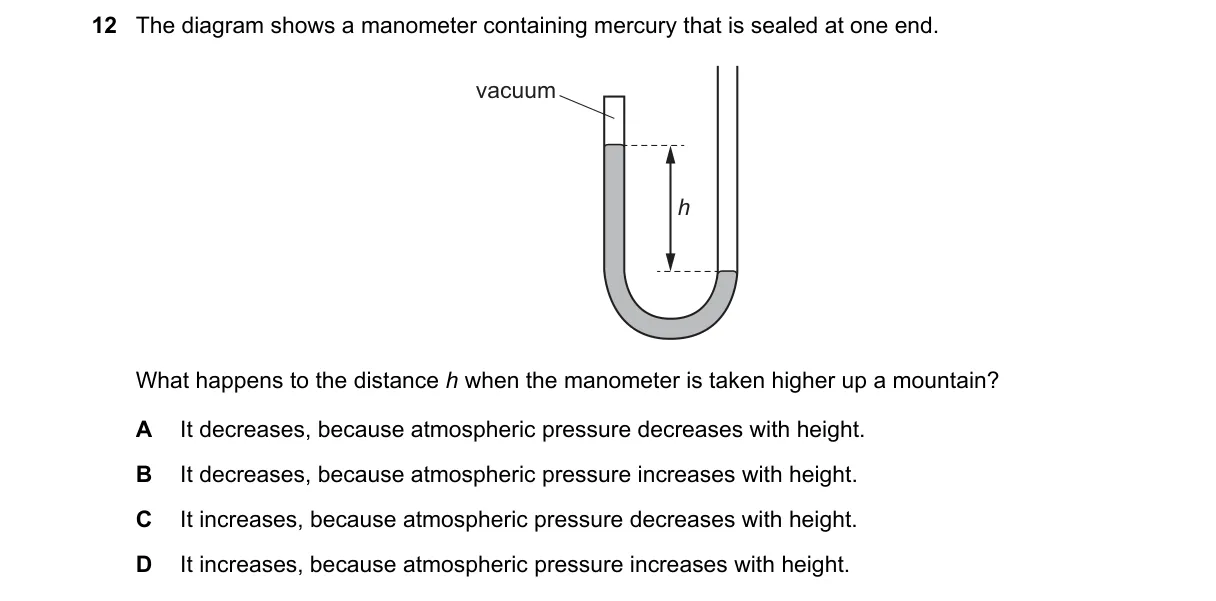
The diagram shows a manometer containing mercury that is sealed at one end. What happens to the distance h when the manometer is taken higher up a mountain?
Answer choices
- AIt decreases, because atmospheric pressure decreases with height.
- BIt increases, because atmospheric pressure increases with height.
- CIt decreases, because atmospheric pressure increases with height.
- DIt increases, because atmospheric pressure decreases with height.
Explanation
Atmospheric Pressure in Closed Manometer
Steps:
- A sealed-end manometer measures absolute atmospheric pressure; the sealed side is vacuum.
- Atmospheric pressure pushes mercury up the sealed tube, creating height difference h.
- h equals P_atm / (ρg), where ρ is mercury density and g is gravity.
- At higher altitude, P_atm decreases, so h decreases.
Why A is correct:
- Boyle's law and barometric formula show P_atm drops with height, reducing h in the manometer equation.
Why the others are wrong:
- B: Atmospheric pressure decreases, not increases, with height.
- C: Atmospheric pressure decreases, not increases, with height.
- D: Decreased pressure causes h to decrease, not increase.
Final answer: A
Topic: Pressure
Practice more O Levels/IGCSE Physics (5054) questions on mMCQ.me