O Levels/IGCSE Physics (5054)•5054/12/M/J/18
O Levels/IGCSE Physics (5054) — 5054/12/M/J/18, Question 31
The diagram shows a loudspeaker that is producing a continuous sound wave of frequency 200 Hz in air. Which diagram best shows how the sound wave causes a molecule at P to move
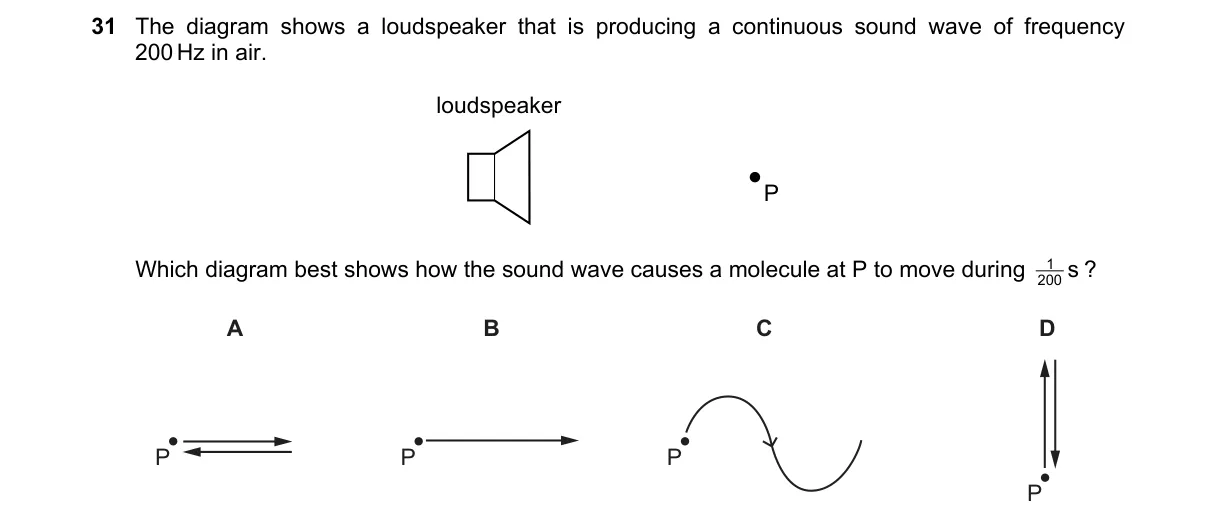
Answer choices
- AOption A
- BOption B
- COption C
- DOption D
Explanation
Sound waves cause longitudinal motion in air molecules
Steps:
- Sound waves are longitudinal, meaning molecules vibrate parallel to the wave's propagation direction.
- A loudspeaker produces compressions and rarefactions that push-pull molecules along this axis.
- At point P, the molecule oscillates back and forth in the direction of wave travel, matching the 200 Hz frequency.
- Diagram A depicts this linear, parallel displacement.
Why A is correct:
- Longitudinal waves, by definition, involve particle motion parallel to propagation, as per wave mechanics.
Why the others are wrong:
- B shows transverse motion perpendicular to propagation, incorrect for sound in air.
- C depicts circular or elliptical paths, not applicable to linear sound vibrations.
- D illustrates radial or no displacement, ignoring the oscillatory nature of sound.
Final answer: A
Topic: Sound
Practice more O Levels/IGCSE Physics (5054) questions on mMCQ.me