O Levels/IGCSE Physics (5054)•5054/12/M/J/18
O Levels/IGCSE Physics (5054) — 5054/12/M/J/18, Question 20
Equal masses of copper and water are heated to the same temperature. As they cool, the temperature of the copper falls faster. Why is this?
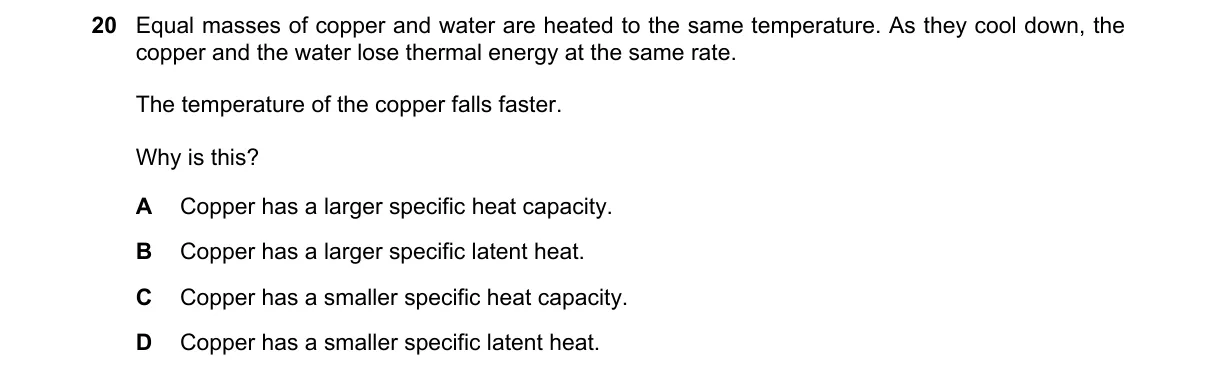
Answer choices
- ACopper has a larger specific heat capacity.
- BCopper has a smaller specific heat capacity.
- CCopper has a larger specific latent heat.
- DCopper has a smaller specific latent heat.
Explanation
Specific heat capacity determines cooling rate
Steps:
- Equal masses of copper and water start at the same high temperature and cool by losing heat to surroundings.
- Heat loss rate depends on surface area, emissivity, and temperature difference, assumed similar for both.
- Temperature change ΔT = Q / (m c), where Q is heat lost, m is mass, c is specific heat capacity.
- For same m and Q, smaller c causes larger ΔT, so faster temperature drop.
Why B is correct:
- Specific heat capacity c is heat needed to raise 1 kg by 1°C; copper's c (385 J/kg°C) is smaller than water's (4186 J/kg°C), so copper cools faster per heat lost.
Why the others are wrong:
- A: Larger c would make copper cool slower, opposite of observed.
- C: Specific latent heat involves phase changes, irrelevant here as no phase change occurs during cooling.
- D: Smaller latent heat also irrelevant without phase change.
Final answer: B
Topic: Specific heat capacity
Practice more O Levels/IGCSE Physics (5054) questions on mMCQ.me