O Levels/IGCSE Physics (5054)•5054/11/M/J/18
O Levels/IGCSE Physics (5054) — 5054/11/M/J/18, Question 35
The circuit diagram shows a variable resistor R connected in parallel to the lower half of a potential divider. The resistance of R increases. What happens to the two voltmeter readings?
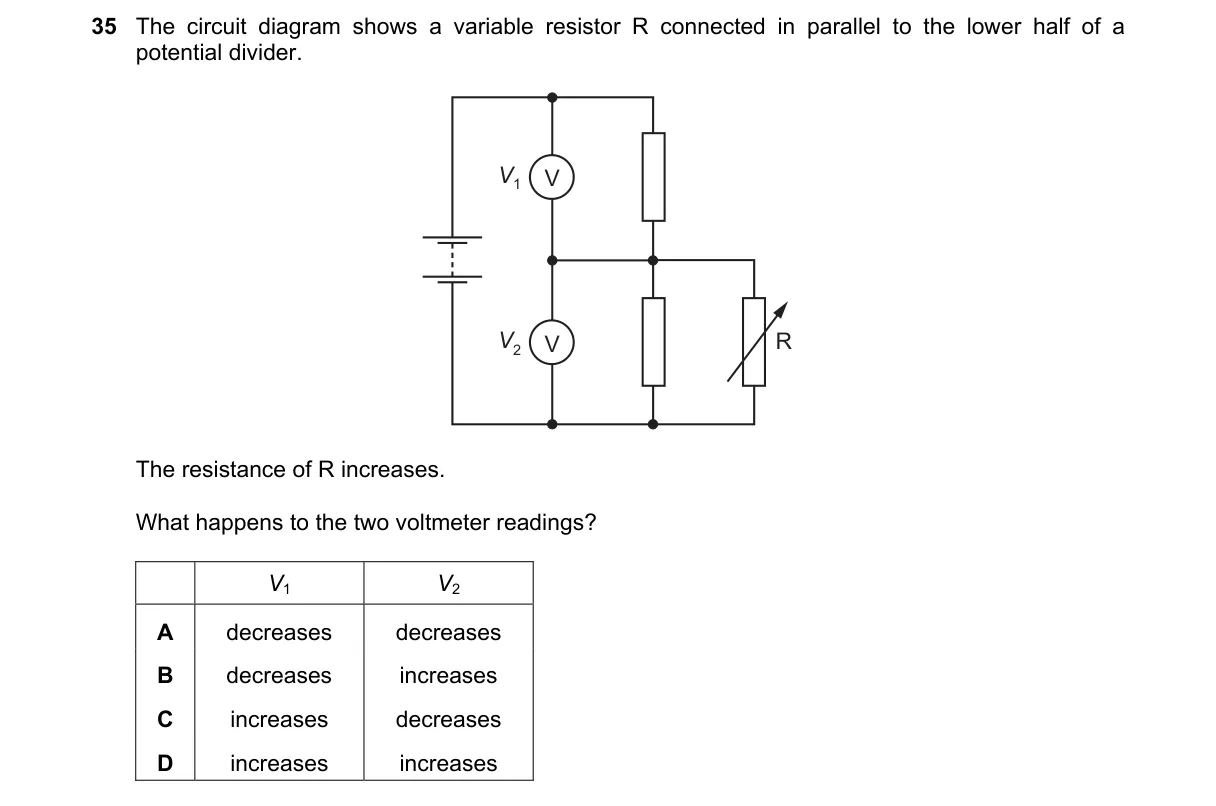
Answer choices
- AV1 decreases V2 decreases
- Bdecreases increases
- Cincreases decreases
- Dincreases increases
Explanation
Increasing parallel resistance boosts lower branch voltage share
Steps:
- Variable resistor R parallels the lower resistor in the potential divider, shunting current through it.
- Increasing R raises the equivalent lower resistance, reducing shunting and increasing its share of total resistance.
- Voltage V2 across lower branch rises per V2 = V_total × (R_lower_eq / R_total).
- Voltage V1 across upper branch falls, as its share decreases with rising R_total.
Why B is correct:
- B matches the potential divider rule: V1 drops as upper fraction shrinks, V2 rises as lower fraction grows.
Why the others are wrong:
- A: Both decrease – V2 actually increases with less shunting.
- C: V1 increases, V2 decreases – reverses the resistance effect on voltage shares.
- D: Both increase – violates fixed total voltage, where gains in one cause losses in the other.
Final answer: B
Topic: Series and parallel circuits
Practice more O Levels/IGCSE Physics (5054) questions on mMCQ.me