O Levels/IGCSE Physics (5054)•5054/11/M/J/18
O Levels/IGCSE Physics (5054) — 5054/11/M/J/18, Question 3
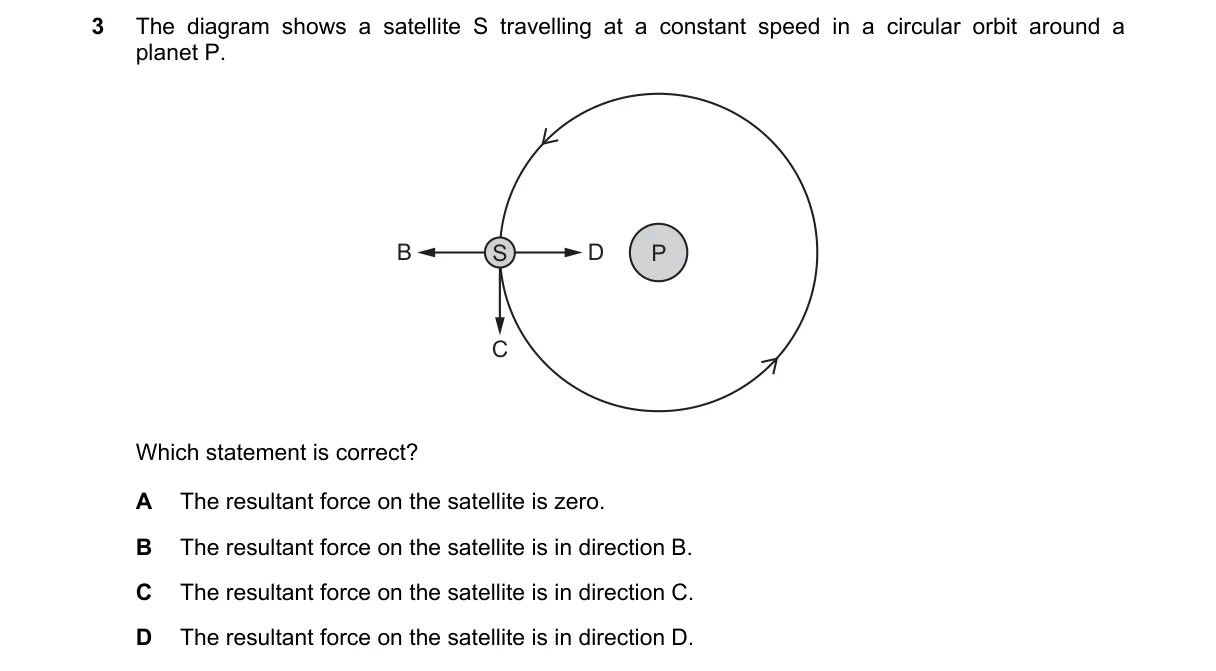
The diagram shows a satellite S travelling at constant speed in a circular orbit around planet P. Which statement is correct?
Answer choices
- AThe resultant force on the satellite is zero.
- BThe resultant force on the satellite is in direction B.
- CThe resultant force on the satellite is in direction C.
- DThe resultant force on the satellite is in direction D.
Explanation
Centripetal Force Directs Satellite's Motion
Steps:
- Satellite orbits at constant speed, requiring centripetal acceleration toward planet P's center.
- Newton's second law states resultant force equals mass times centripetal acceleration, directed inward.
- Gravitational force from P provides this resultant force, radially toward the center.
- Direction D aligns with this inward radial path.
Why D is correct:
- In uniform circular motion, the resultant force must be centripetal, toward the center, as per , matching gravity's direction.
Why the others are wrong:
- A: Resultant force zero implies no acceleration, but circular motion requires centripetal acceleration.
- B: Direction B likely tangential, which would change speed, not sustain constant-speed orbit.
- C: Direction C likely outward or perpendicular, opposing the needed inward pull for orbit.
Final answer: D
Topic: Circular motion
Practice more O Levels/IGCSE Physics (5054) questions on mMCQ.me