O Levels/IGCSE Physics (5054)•5054/11/M/J/18
O Levels/IGCSE Physics (5054) — 5054/11/M/J/18, Question 26
The diagram shows a loudspeaker that is producing a continuous sound wave of frequency 200 Hz in air. Which diagram best shows how the sound wave causes a molecule at P to move
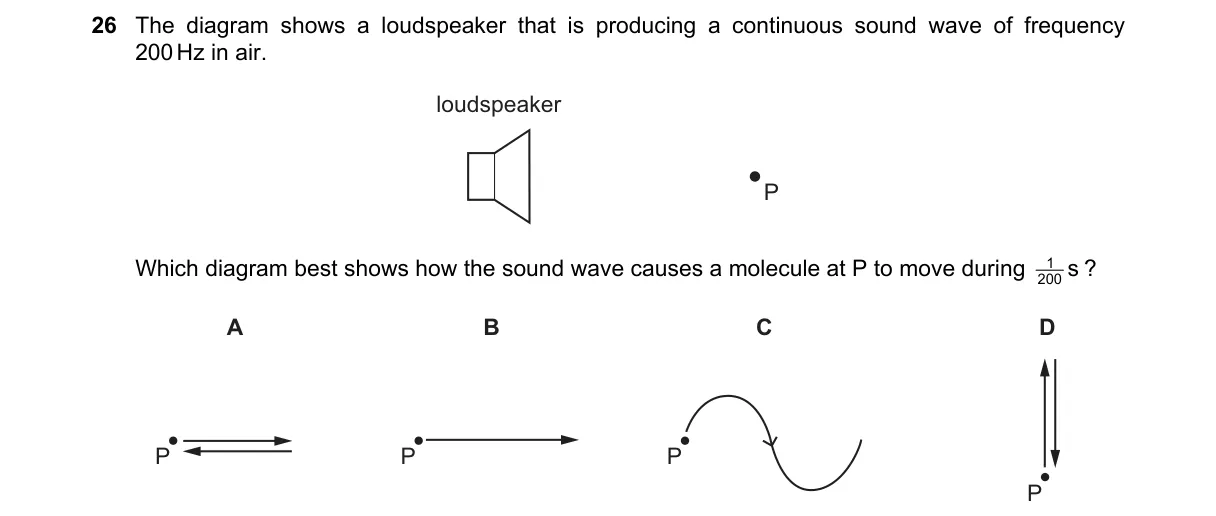
Answer choices
- AOption A
- BOption B
- COption C
- DOption D
Explanation
Sound waves cause longitudinal motion in air molecules
Steps:
- Sound waves are longitudinal, propagating as compressions and rarefactions in air.
- Molecules vibrate parallel to the wave's direction of travel.
- At point P, the molecule oscillates back and forth continuously at 200 Hz.
- Diagram A depicts this to-and-fro motion along the propagation axis.
Why A is correct:
- Longitudinal waves cause particle displacement parallel to propagation, per the definition of sound as a pressure wave.
Why the others are wrong:
- B shows transverse motion perpendicular to propagation, unlike sound waves.
- C shows circular or elliptical paths, not linear oscillation.
- D shows radial expansion or no directed motion, ignoring wave direction.
Final answer: A
Topic: Sound
Practice more O Levels/IGCSE Physics (5054) questions on mMCQ.me