O Levels/IGCSE Economics (2281)•2281/13/O/N/24
O Levels/IGCSE Economics (2281) — 2281/13/O/N/24, Question 8
What can be deduced from these population pyramids?
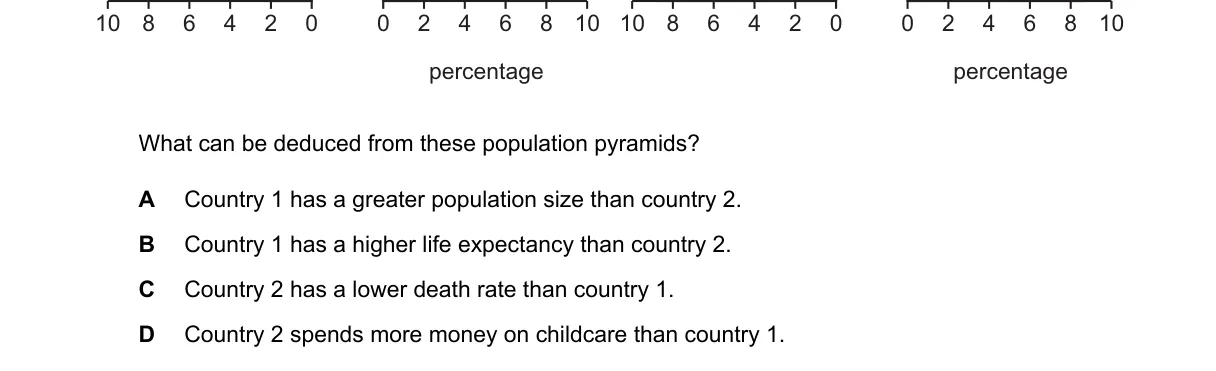
Answer choices
- ACountry 1 has a greater population than country 2.
- BCountry 1 has a higher life expectancy than country 2.
- CCountry 2 has a lower death rate than country 1.
- DCountry 2 spends more on childcare than country 1.
Explanation
Population Pyramids Reveal Age Distribution and Life Expectancy
Steps:
- Examine the shape: Broad base indicates high birth rates; narrow top shows high mortality in older ages.
- Compare pyramids: Country 1 likely has a more rectangular shape with fewer deaths at older ages than Country 2's triangular shape.
- Infer life expectancy: Rectangular pyramids suggest people live longer, reaching higher ages evenly.
- Deduce differences: Country 1's structure implies better survival to old age compared to Country 2.
Why B is correct:
- Life expectancy is indicated by the pyramid's width at older ages; a broader elderly population in Country 1 shows higher average lifespan per demographic analysis.
Why the others are wrong:
- A: Total population size requires absolute numbers, not just pyramid proportions.
- C: Death rates relate to base width (births) and overall narrowing, but pyramids alone don't specify rates without scale.
- D: Childcare spending isn't directly visible in age structures; it affects births but lacks evidence here.
Final answer: B
Topic: Population
Practice more O Levels/IGCSE Economics (2281) questions on mMCQ.me